
Poor sleep, racing thoughts, jaw tension, and that exhausted-but-wired feeling are rarely separate problems. Here is what connects them – and what most people never think to address.

Thomas Hottmann is a naturopath, certified nurse and functional medicine practitioner based in Hilzingen, Germany. He has spent over a decade working with people whose bodies stay stuck in high-alert mode long after the working day ends – and whose standard recovery tools have stopped delivering results.
I see the same pattern almost every week in my practice.
Someone comes in exhausted. They have tried the screen time limits, the magnesium before bed, the “do not disturb” mode. Some have blue light glasses. Some have a whole wind-down routine.
The details differ. A nurse who cannot stop replaying a difficult shift. A teacher who keeps rehearsing tomorrow’s lesson while trying to sleep. A project manager whose mind is already in Monday’s kickoff meeting.
The pattern underneath is always the same.
And still – the moment the laptop closes, the mind opens.
They lie there replaying the meeting from this afternoon. Running through tomorrow’s agenda. The body is in bed. The brain is still at the office.
By 3am, something jolts them awake. By 7am, the alarm feels like an assault. By 9am, the second coffee has already stopped working.
This is not a sleep problem. It is not a discipline problem. It is a nervous system problem. And it responds to a very different kind of intervention.
Here is what I see connecting all of it – and why an increasing number of people are turning to vagus nerve stimulation as a result.

Your Brain Never Got the “Work Is Over” Signal – So It Never Stopped Working

You close the laptop. You make dinner. You watch something. You go to bed.
And somewhere between the last Slack notification and the moment your head hits the pillow – nothing actually switched off.
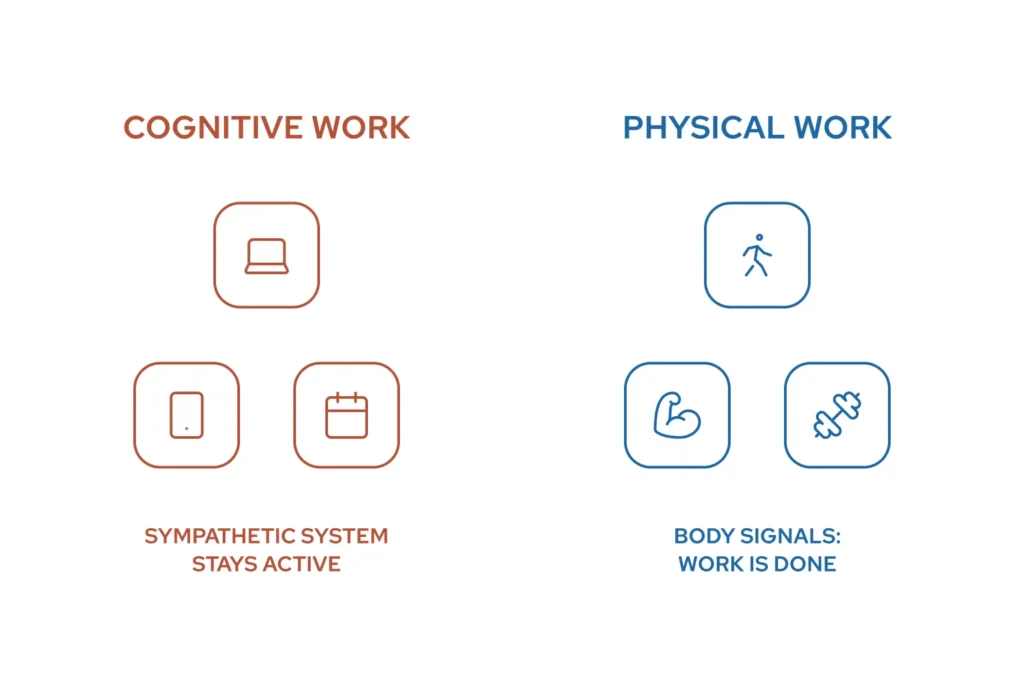
Your autonomic nervous system has two primary states. Sympathetic (fight-or-flight) – keeps you alert, activated, scanning for threats. Parasympathetic (rest and recover) – where genuine restoration happens. The vagus nerve is the body’s primary pathway for shifting between the two.
For people who work with their brain all day, the sympathetic system stays activated for hours at a stretch. Unlike physical labour, which exhausts the body and sends a clear “work is done” signal, cognitive work produces no such signal.
The nervous system has no way of knowing the workday ended. So it continues doing what it was doing all day.
The laptop closes. The threat-scanning does not.
The racing thoughts, the replaying of conversations, the mental preparation for tomorrow – these are not personality traits. They are a nervous system that was never told it was safe to stop.
VNS – Vagus Nerve Stimulation – works differently from every other wind-down tool. Rather than asking an already-activated nervous system to calm itself through effort, VNS delivers a direct signal to the brainstem, activating the parasympathetic pathway from the source.
The most direct form of this is taVNS – Transcutaneous Auricular Vagus Nerve Stimulation – a non-invasive method that delivers gentle electrical pulses through the outer ear directly to the vagus nerve.
In peer-reviewed scientific studies, a single VNS session produced a 61% increase in vagal nerve activity within five minutes.
What People Notice:
- Lying down and the mental to-do list not immediately starting up
- Falling asleep without having to fight your own brain
- Waking up and not being able to remember what you were worrying about last night
“After years of being stuck in a fight or flight response, the Nuropod has been essential in restoring my system back to normal.” — Deborah Knopf, Trustpilot

Your Body Is Holding the Stress Your Mind Has Already Moved Past
Most people who carry this kind of load would say they are fine. They handled the day. They got through it.
Then ask them when they last noticed their jaw unclenched. Their shoulders dropped away from their ears. Their chest felt genuinely loose.
Most pause before answering.
Chronic sympathetic dominance manifests physically – jaw tension, teeth grinding during sleep, tight shoulders, shallow breathing.
The muscles that respond to threat remain partially contracted long after the actual pressure has passed. Not painfully. Just persistently. Enough that the body never fully releases between one working day and the next.
This is why people wake up stiff. Why the night guard the dentist prescribed keeps getting worn down. Why a massage feels necessary every few weeks just to function normally.
By directly activating the parasympathetic pathway through the auricular branch of the vagus nerve, taVNS works at the autonomic level – supporting a systemic release that surface-level tools alone cannot always achieve.
What People Notice:
- Waking up without the jaw soreness or neck stiffness that had become normal
- Realising mid-evening that your shoulders have actually dropped
- Not needing a massage every few weeks just to feel physically normal again
“The tension I’d been carrying in my shoulders and jaw for years has noticeably reduced. I didn’t realise how much I was holding until it started releasing.” – verified user, Trustpilot

The 3am Wake-Up Is Not About What You Ate – It Is About Your Cortisol Spiking
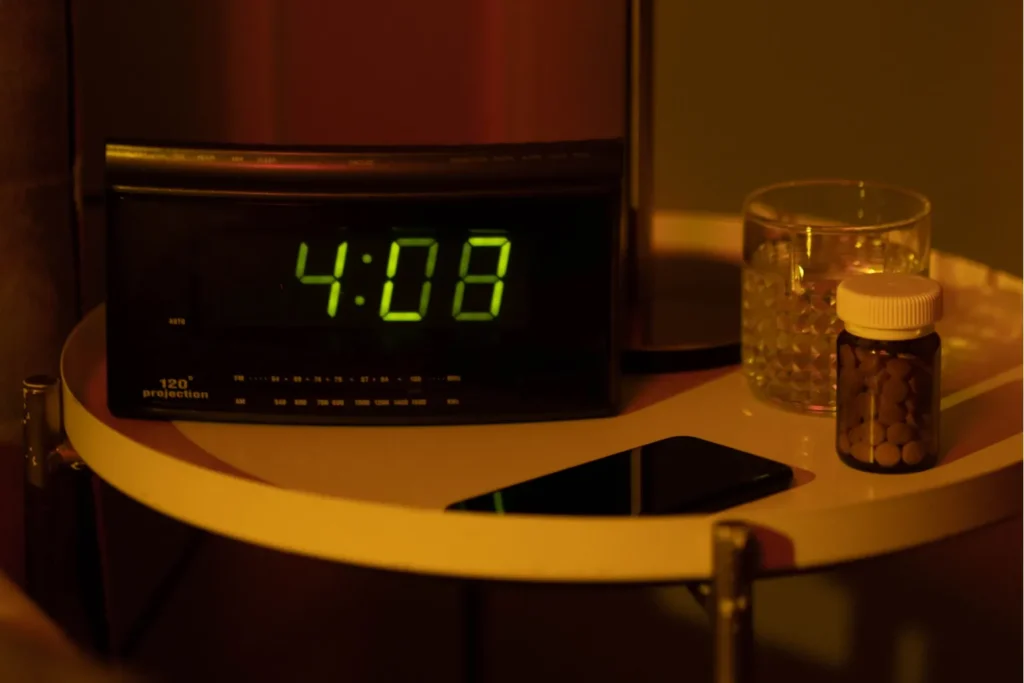
It is one of the most common complaints I hear. Everything is fine – relatively. Life is manageable. And yet, reliably, somewhere between 2am and 4am, something jolts them awake.
Heart slightly racing. Mind immediately active. No obvious reason.
They check the phone – which makes it worse. By 5am they drift off again. By 7am the alarm feels catastrophic.
Most people blame what they ate, how much they drank, the temperature of the room. They try chamomile tea, valerian, white noise apps.
The actual driver is rarely any of these things.
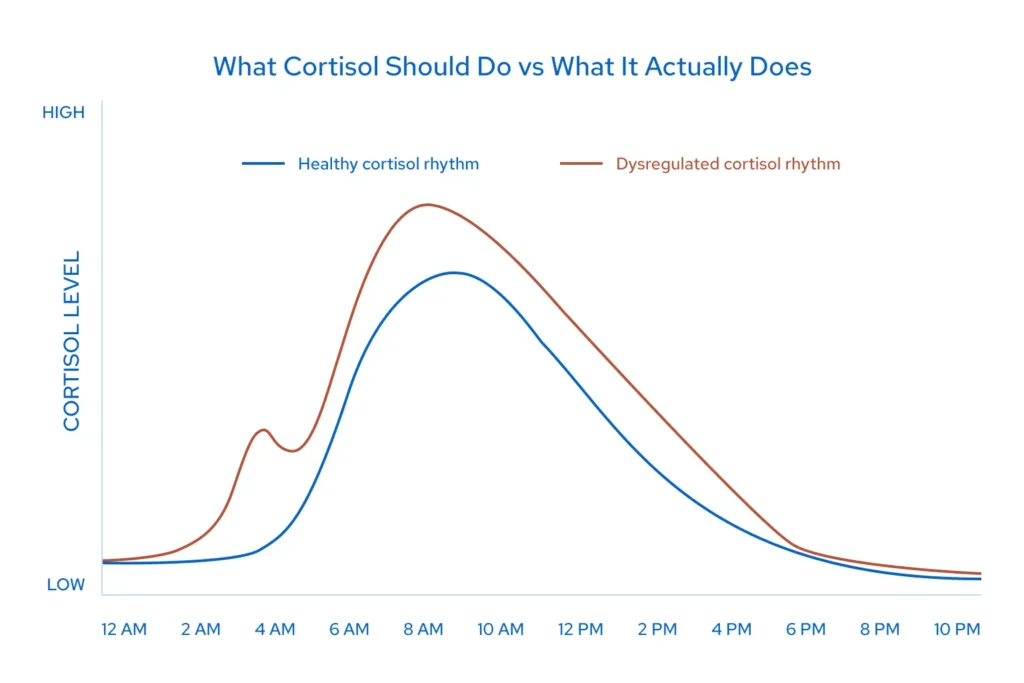
In people with dysregulated autonomic nervous systems, cortisol patterns shift. Cortisol is supposed to be lowest in the middle of the night and rise gradually toward waking.
In people whose nervous systems have been in chronic activation, this rhythm inverts – cortisol rises too early, typically between 2am and 4am, pulling the body out of deep sleep before restoration is complete.
This is not a sleep problem . It is an autonomic regulation problem.
In peer-reviewed scientific studies, supporting vagal tone through stimulation produced a -35% reduction in anxious thoughts and measurable improvements in overnight autonomic balance.
What People Notice:
- Sleeping through 3am without being jolted awake
- Going back to sleep easily on the rare occasion you do wake
- Waking at your alarm instead of an hour before it, already tense
“After 2 years of serious sleep issues, I sleep deeper and longer than ever.” – Kenny, Trustpilot
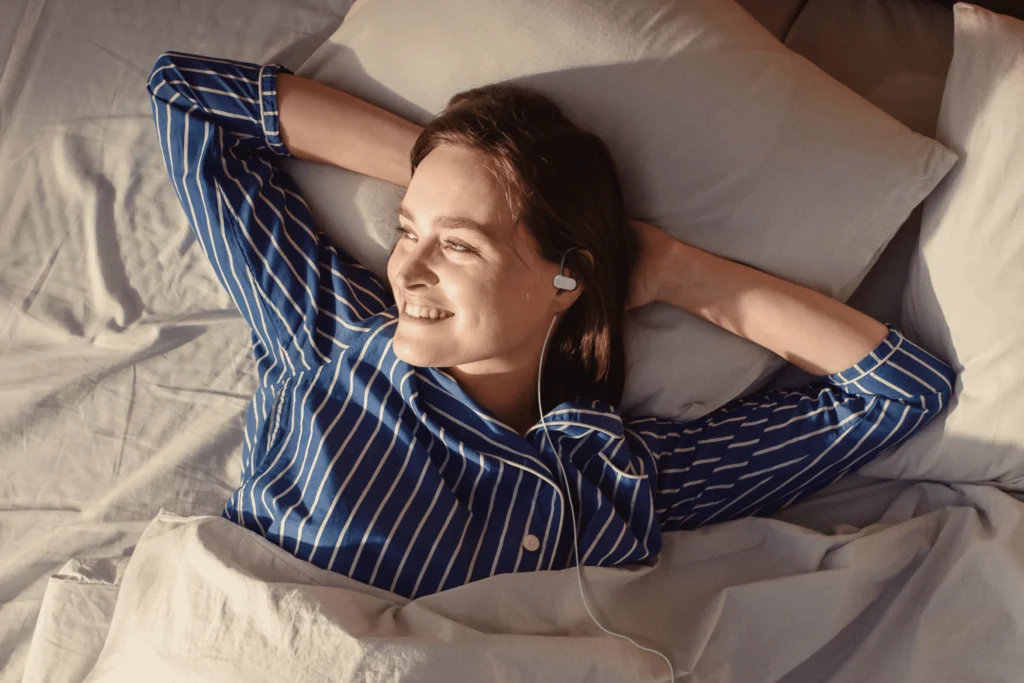

Seven Hours in Bed Is Not Seven Hours of Recovery – Here Is the Difference
Seven hours. Sometimes eight. Everything in place. And still wrong.
They go to bed at a reasonable hour. Blue light glasses on. “Do not disturb” mode active. Room dark and cool.
And they wake up feeling like they barely slept.
The hours are not the problem. What the nervous system does during those hours is.
Deep slow-wave sleep – where growth hormone releases, tissue repair happens, and immune maintenance occurs – requires sustained parasympathetic dominance. REM sleep – where emotional processing and memory consolidation happen – is similarly dependent on autonomic state.
When sympathetic dominance carries over into the night, the body cycles through lighter stages and cuts the deep phases short. The hours go in. The restoration does not.
This is why people who track their sleep see seven hours logged but a recovery score of 35%.
In peer-reviewed scientific studies, supporting vagal tone through stimulation produced a +30% improvement in sleep quality and a -48% reduction in tiredness – sustained even one week after discontinuing use.
What People Notice:
- Waking up feeling like the night actually did something - before you have done anything to make it happen
- Getting to midday without the familiar fog settling in
- Waking up and actually wanting to get up
“My sleep tracker finally started showing recovery scores above 70%. Seven hours that actually feel like seven hours.” – verified user, Trustpilot

Melatonin, Magnesium and Ashwagandha Target the Symptom – Not the System

Most people I see have already tried the standard toolkit.
Melatonin – helpful for jet lag and circadian rhythm (the body’s internal 24-hour clock) shifts, but not designed for nervous systems stuck in sympathetic dominance. Magnesium glycinate – genuinely useful for muscle relaxation and sleep onset, but working at the muscular level rather than the autonomic one. Ashwagandha – an adaptogen that can modulate cortisol over time, but addressing one input rather than the regulatory system itself.
None of these are wrong. They are simply working one layer above where the actual problem is.
I will be direct about my own scepticism here. When I first encountered vagus nerve stimulation devices marketed for sleep and stress, my instinct as a practitioner was to dismiss them. The wellness space is full of devices claiming to regulate the nervous system without serious evidence behind them.
What changed my position was the research. I went through the peer-reviewed scientific literature on taVNS – specifically which devices had been validated in placebo-controlled studies rather than simply marketed as vagal stimulators.
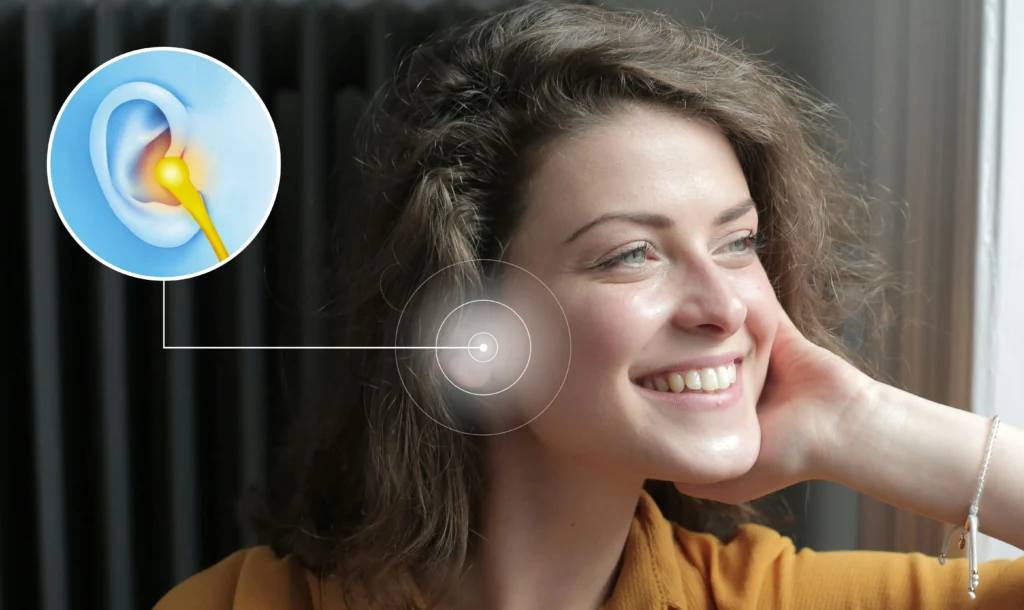
Among the devices I researched, Nuropod stood out for the depth of scientific evidence behind it.
It is a CE-marked taVNS device backed by over 60 independent scientific studies across 150+ internationally recognised institutions including King’s College London, UCL (University College London), and Imperial College London. The CE certification means it has passed safety and efficacy standards under European medical device regulation – a threshold most wellness gadgets have not cleared.

What People Notice:
- The edge coming off in the evening in a way supplements never quite achieved
- Sleep improving not by adding more to the routine - but by addressing what the routine could not reach
- Mornings feeling different before you have done anything differently
“After trying melatonin, magnesium and various supplements for years, this is the first thing that has actually moved my HRV and changed how I feel in the mornings.” – verified user, Trustpilot

Why You Need Three Coffees to Function – And Why Caffeine Is Not the Answer

Most people do not notice brain fog arriving. They just notice that by mid-morning, thinking feels slower. Decisions that should be simple take longer. A meeting that requires focus feels like wading through something thick.
By afternoon, the third coffee has stopped working. By 6pm, they are too tired to think clearly but too wired to properly rest.
This is not a caffeine problem. It is what happens when the nervous system never completed its recovery overnight.
Deep sleep is where the brain consolidates information and clears metabolic waste through the glymphatic system – the brain’s own cleaning mechanism, active only during deep sleep. When sympathetic dominance interrupts deep sleep, this restoration is cut short.
The result is not simply tiredness. It is reduced working memory, slower processing speed, lower tolerance for ambiguity, and a shorter fuse – the precise combination that makes demanding work feel disproportionately hard.
Caffeine masks the symptom. It does not restore what the nervous system failed to rebuild overnight.
In peer-reviewed scientific studies, supporting vagal tone through stimulation produced measurable improvements in tiredness and cognitive function – sustained even one week after discontinuing use.
What People Notice:
- Thinking more clearly in morning meetings without the second coffee
- Decisions that felt heavy becoming easier to make
- Getting to Friday without running purely on momentum and willpower
“I notice I’m sharper in the mornings. The brain fog I’d accepted as normal has largely gone.” – verified user, Trustpilot

Sunday Evening Already Feels Like Monday – Because Your Nervous System Never Left

Saturday is fine. There is genuine decompression – plans, movement, time with people. But by Sunday afternoon, something shifts.
A low-level dread settles. The mental rehearsal begins. The inbox gets mentally checked. The week ahead is being pre-loaded before it has started.
This is not anxious thoughts in the conventional sense. It is an autonomic nervous system that has been in sustained activation for so long that it treats the approaching workweek as a threat – automatically, without input.
The deeper problem: the weekend itself is no longer functioning as recovery. The hours are there. The absence of work is technically there. But if the nervous system never fully shifts into parasympathetic recovery mode, the restoration that weekends are supposed to deliver simply does not happen.
This is why so many people arrive on Monday already tired. Not because they did not rest. Because the system responsible for converting rest into recovery has been running underpowered for months.
By directly supporting vagal tone, the shift into genuine recovery becomes possible again. Not just on weekday evenings. During weekends too.
What People Notice:
- Sunday evenings feeling quieter - the week not already loading before it has started
- Arriving on Monday with something actually left
- Weekends beginning to do what weekends are supposed to do
“It’s a really easy thing I’ve just implemented into my everyday life.” – verified user, Trustpilot
The Evidence Behind It
The research behind vagus nerve stimulation has been building for over a decade across more than 60 independent scientific studies. Here is what Nuropod specifically delivers:
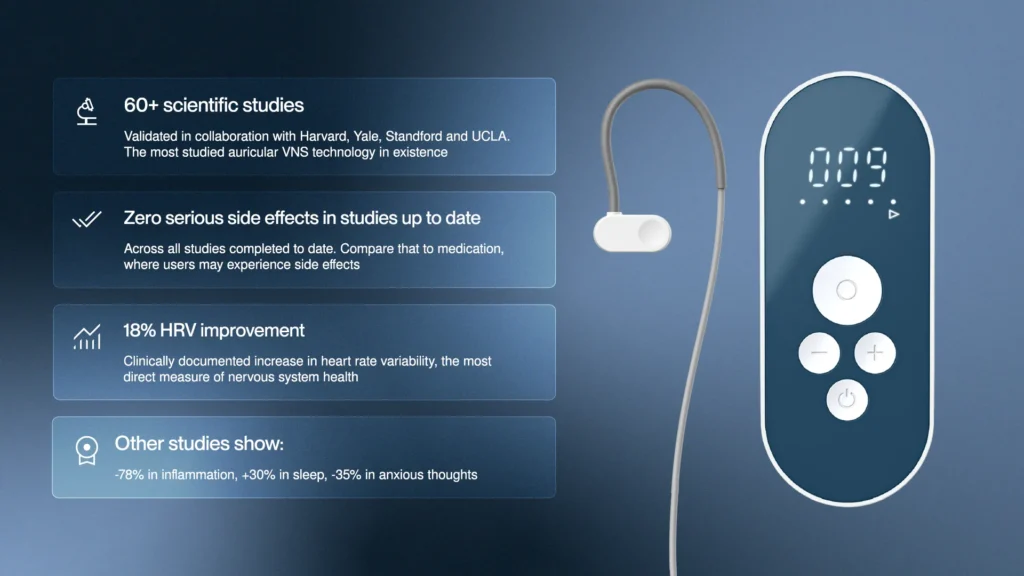
- +61% increase in vagal nerve activity within five minutes of a session
- +18% increase in HRV (Heart Rate Variability) - a single session favourably altered all parameters compared to placebo
- -78% reduction in IL-6 (Interleukin-6) inflammatory cytokines
- -48% reduction in tiredness scores, sustained one week after discontinuing use
- +30% improvement in sleep quality over four weeks
- -35% reduction in anxious thoughts
- +80% improvement in GI (Gastrointestinal) symptoms
Results from peer-reviewed studies in specific study populations. Figures reflect relative change compared to placebo or baseline. Individual results may vary.
How It Fits Into a Real Day

In my practice, I recommend Nuropod as one layer of a broader approach – not as a replacement for sleep, nutrition, boundaries, or addressing what created the dysregulation in the first place.
I suggest building sessions around existing gaps in the day rather than carving out new time:
Lunch break: 15-20 minutes clipped to the ear while eating or stepping away from the screen. The break is already there – this changes what happens during it.
End of the working day: 30 minutes during the transition between work and evening. This is the window where the nervous system most needs the shift signal.
Before sleep: 30-60 minutes while reading or winding down – particularly useful for people whose mind tends to accelerate the moment the environment quietens.
The sensation is a gentle tingle – adjustable, nothing dramatic. You can wear it while eating, reading, or simply sitting. Not during the working session itself.
Most people find it takes two to three weeks of consistent use before the changes become clearly noticeable. The shift is not dramatic. But it is measurable. And it holds.
Who Might Benefit
May benefit:
- Healthcare workers and nurses whose shifts follow them home long after they have left the building
- Teachers and educators who cannot stop replaying the day once the classroom empties
- Project managers and middle managers caught between competing demands with no clean off switch
- Tech workers and remote professionals whose working day has no clear ending point
- Freelancers and digital nomads whose work follows them across time zones and weekends
- Parents and carers managing sustained output without adequate recovery built in
- Anyone whose recovery tools - melatonin, magnesium, ashwagandha - have plateaued or stopped working
Do not use if you have a pacemaker or implantable cardiac device, are pregnant, have had a recent serious cardiac event, or are under 18. Always consult a qualified healthcare professional before starting.
A Safe Way to Explore It
- 30-day money-back guarantee - enough time to see whether your sleep and morning energy actually shift
- Limited subsidised research slots - some participants may receive up to €70 off in exchange for sharing their experience
A Final Note From My Practice
The people I see who struggle most with this pattern are not struggling because they lack discipline. Most are highly capable, self-aware people who have already tried the obvious things.
What I notice beyond the sleep disruption and tiredness is a quieter erosion they rarely mention first. The irritability that arrives by Wednesday. The shorter fuse with people they care about. The enthusiasm for things they used to enjoy that has slowly flattened.
Running on empty does not only affect performance. It affects who you are in the hours outside work.
The circumstances differ from person to person. The nervous system pattern is the same.
When the nervous system has been in sustained activation long enough, it needs more than a wind-down routine. It needs a direct signal that it is safe to recover. That is what the vagus nerve provides.
Most of my users describe the change not as dramatic improvement but as the quiet return of something they had stopped noticing was gone. Not a transformation. A restoration.
References
- Geng D, et al. The effect of transcutaneous auricular vagus nerve stimulation on HRV. PLoS ONE. 2022. https://doi.org/10.1371/journal.pone.0263833
- Dasari TW, et al. Low-level tragus stimulation reduces systemic inflammation. Clinical Autonomic Research. 2023. https://pmc.ncbi.nlm.nih.gov/articles/PMC10543293/
- Forte G, et al. Ear your heart: taVNS on heart rate variability. PeerJ. 2022. https://pubmed.ncbi.nlm.nih.gov/36438582/
- Ferstl M,, et al. Non-invasive vagus nerve stimulation boosts mood recovery after effort exertion. 2021. https://www.ncbi.nlm.nih.gov/pmc/articles/PMC9693679/
- Dolcini J, et al. Effects of taVNS on sleep quality: Randomised controlled study. 2025.
- Breit S, et al. Vagus nerve as modulator of the brain-gut axis. Frontiers in Psychiatry. 2018. https://www.frontiersin.org/articles/10.3389/fpsyt.2018.00044/full
- Zhu S, et al. taVNS enhanced emotional inhibitory control. International Journal of Clinical and Health Psychology. 2024. https://pubmed.ncbi.nlm.nih.gov/38665809/
- Farmer AD, et al. International consensus based review on taVNS. Frontiers in Human Neuroscience. 2021. https://www.frontiersin.org/articles/10.3389/fnhum.2020.568051/full
- Smith CL, et al. Sedentary work linked to 37% higher risk of insomnia symptoms. Journal of Occupational Health Psychology. 2025. https://psycnet.apa.org/manuscript/2025-58377-002.pdf




Night owl as they say but still my absolute work is during the day and not at night