
It’s 7pm.
You closed your laptop an hour ago. The commute is done. You’re home.
And yet.
Your brain is still at the office.
You’re replaying the meeting from this afternoon. Running through tomorrow’s to-do list. Half-watching something on TV while mentally composing an email you haven’t sent yet.
You know you’re tired. Your body is telling you that clearly enough.
But your mind won’t land.
And later – somewhere between 2 and 4 in the morning – your eyes snap open. Already alert. Already thinking. As if some part of you never actually stopped.
If this sounds familiar, I want to say something that many people I work with are surprised to learn:
Your nervous system may not be receiving the signal that the working day is over.
What I Keep Seeing – In Client After Client
I’ve been working as a cognitive hypnotherapist for over a decade, helping people with anxiety, burnout, chronic stress, insomnia, and emotional overwhelm – particularly people in demanding jobs, long hours at a desk, and high-pressure environments.
When people sit down with me, they often say:
“You must think I’m crazy.”
“You’ve probably never heard anything like this before.”
And I always tell them the same thing: everybody comes with a bowl of spaghetti. Tangled, overwhelming, impossible to see clearly. What we do together is help it become organised – flatter, clearer, easier to understand.
But with one particular pattern, I kept noticing something that felt different from ordinary stress.
These people were exhausted. Genuinely, deeply exhausted.
And yet somehow still alert. Still scanning. Still on.
As if their nervous system never fully got the message that the stressful part was over.
One client described it to me perfectly:
“My body feels tired but my brain is wide awake.”
The Surprising Reason Your Brain Won’t Switch Off After Work
Here is something most stress advice never tells you.
Your nervous system cannot always tell the difference between a deadline and a physical threat.
To your body, back-to-back meetings, a difficult conversation with a manager, a full inbox waiting for you, the pressure of always being available – these register as ongoing demand. As something to stay ready for.
And so it stays ready.
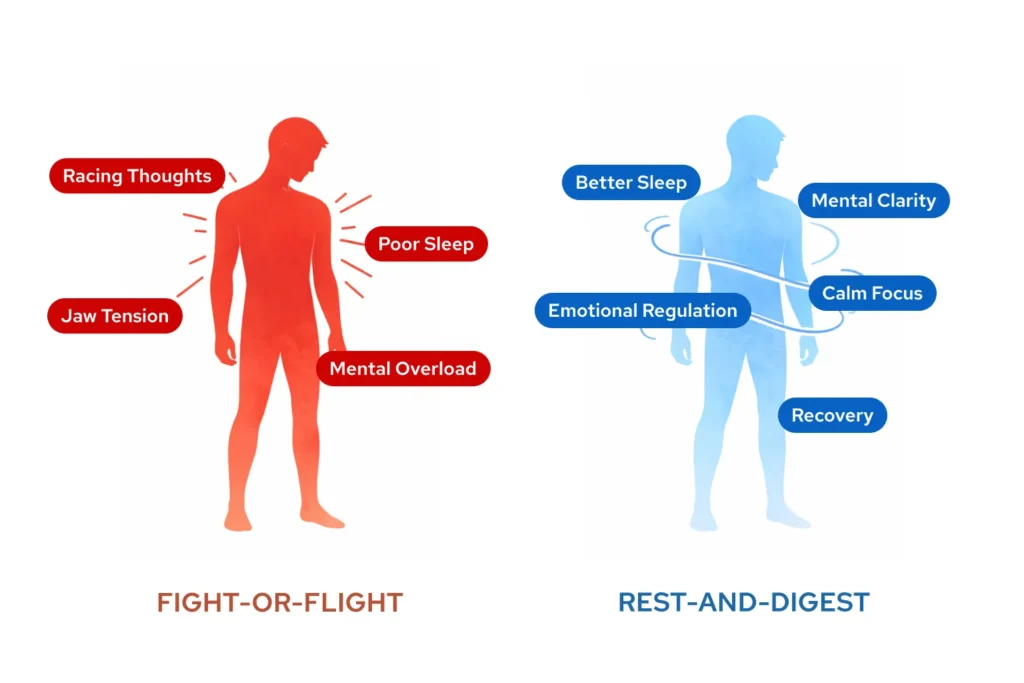
Your autonomic nervous system has two primary modes:
- Sympathetic - fight or flight. Alert, activated, scanning for threat.
- Parasympathetic - rest and digest. Safe, calm, able to recover.
For most of human history, the switch between the two was relatively clean. The threat ended. The body stood down.
But modern work stress rarely ends cleanly.
The emails keep coming after 6pm. The projects follow you home mentally even when you’ve physically left. The sense of responsibility doesn’t clock off when you do.
And because many of those pressures never fully stop, the body can slowly adapt to staying slightly braced – all the time. Even during quiet moments. Even when you’re trying to relax.
Over time, if this continues long enough, something shifts.
The nervous system begins to treat alertness as the normal setting.
And then the body stops knowing how to fully come down – even when you want it to, even when you’re trying, even when you’re exhausted.
That is why you can finish work, sit on the sofa, do everything you’re supposed to do – and still feel like you never quite switched off.
It is not a willpower problem. It is not that you’re bad at relaxing.
It is a nervous system that learned to stay on – and hasn’t yet received the signal that it’s safe to stop.
Why Everything You’ve Tried Probably Hasn’t Fixed It
Most stress advice assumes that if you can just create the right conditions – the right routine, the right environment, the right amount of quiet – your nervous system will naturally settle.
And that is true for a nervous system that is mildly overloaded.
But for a nervous system that has spent weeks or months – sometimes years – in a state of sustained activation, the standard tools often fall short.
Not because they are bad advice. But because they ask for something a chronically activated nervous system often cannot reliably provide:
- Uninterrupted mental space
- Consistent effort
- The ability to be fully present
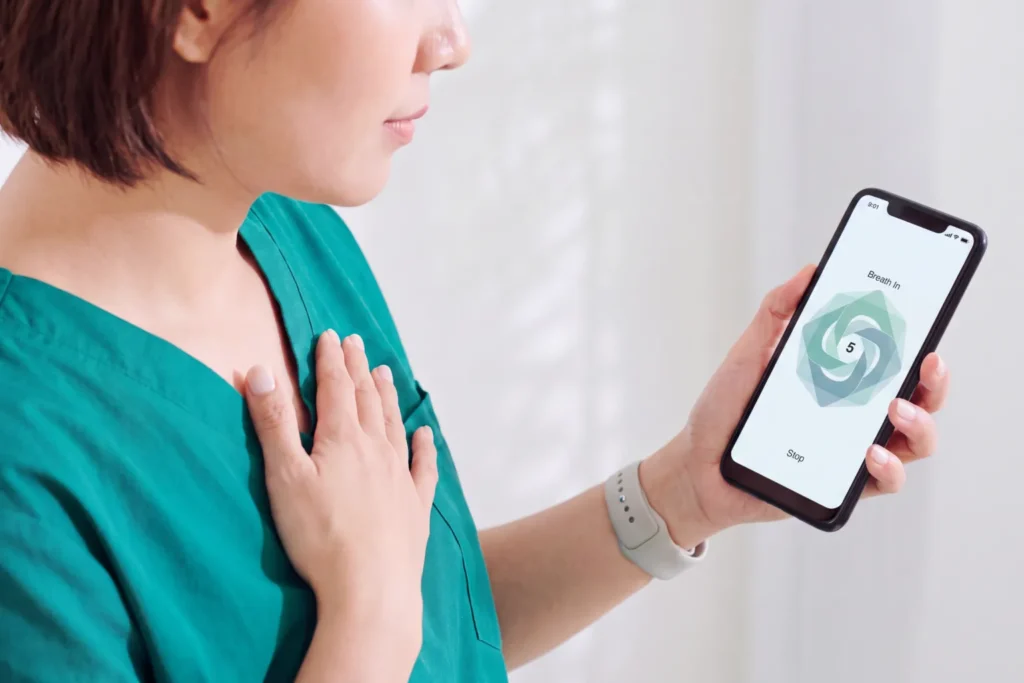
Most people I work with have already tried the meditation app. The breathing exercises. The earlier bedtimes. The journaling.
Some helped, temporarily. But the pattern kept returning.
Because what they were doing was managing the symptoms – not reaching the system that was producing them.
I have always felt that the problem is rarely the person. It is the way most stress support is designed.
It asks overwhelmed people to actively calm themselves down. But many people stuck in constant alert mode are already operating at the edge of their mental capacity before those practices have even begun.
What was needed was something that could work with the nervous system directly – without depending on the person first finding reserves of focus and calm they had already run out of.
The Pathway Most People In Overdrive Never Hear About
The more I looked into chronic stress patterns, the more one pathway kept appearing.
The vagus nerve.
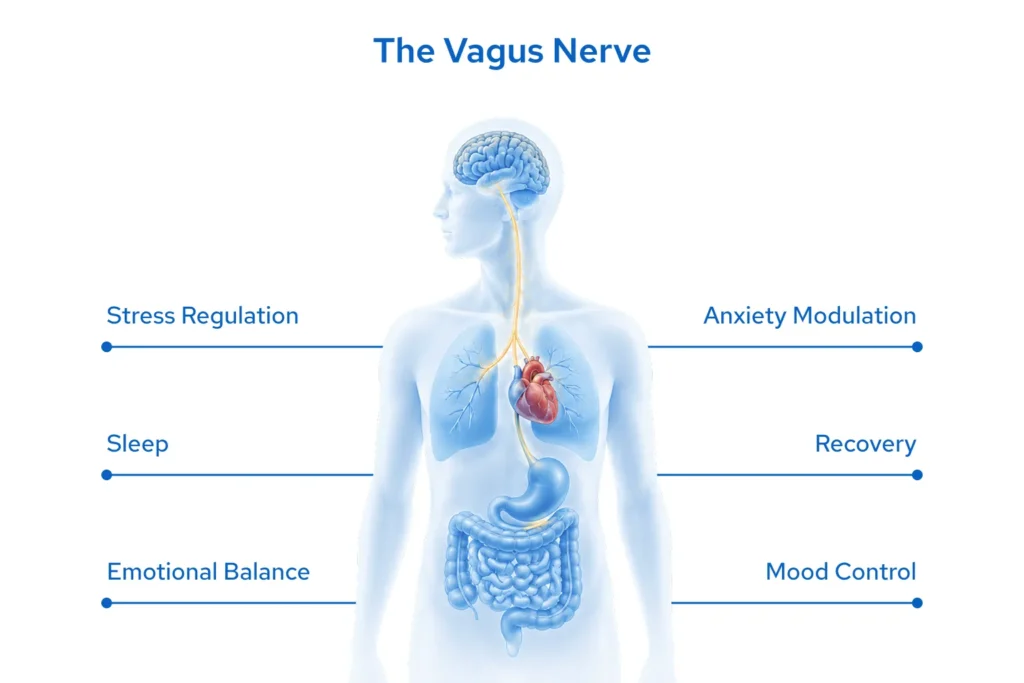
In simple terms, the vagus nerve is the body’s primary communication line for one very specific message:
The threat has passed. It is safe to let go now.
It runs from the brainstem through the heart, lungs, and digestive system – and it plays a central role in helping the nervous system shift out of fight-or-flight and back toward a calmer, more regulated state.
Think of it as the body’s internal calm switch.
When vagal tone is strong, the body can move between activation and recovery relatively naturally. You finish a hard day, and the nervous system gradually follows you home – settling, softening, letting go.
When vagal tone is reduced – which commonly develops in people under sustained pressure – that switch becomes harder to activate:
- The body stays slightly braced
- Sleep becomes lighter
- The mind keeps scanning
- Recovery stops happening the way it should
This is why many people with chronically elevated stress describe not just poor sleep, but a whole cluster of things arriving together: difficulty relaxing in the evenings, a low hum of tension they cannot explain, waking that feels more like surfacing than drifting, fatigue that sleep does not seem to fix.
The nervous system is not broken. It is doing exactly what it was designed to do under prolonged pressure.
It just hasn’t received the signal that the pressure is over.
What Made Me Take This Seriously

Around this time, I started paying closer attention to a newer non-invasive approach known as taVNS – transcutaneous auricular vagus nerve stimulation.
As I continued exploring that area, one device kept appearing again and again. Not in wellness marketing – but in clinical research discussions and practitioner conversations I was following online.
That device was Nuropod.
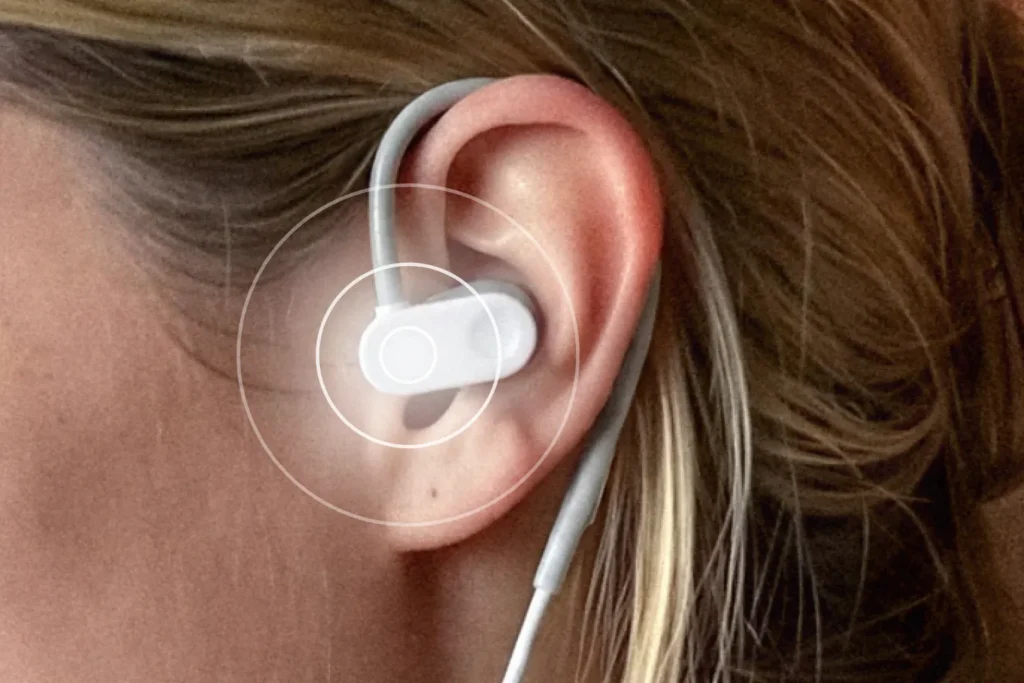
It did not require silence, a special environment, or stepping away from ordinary life. You could wear it at your desk. While answering emails. While doing anything that did not require intense physical movement.
For people who spend most of their day at a screen and most of their evening still mentally at work – that detail felt significant.
Years ago, direct vagus nerve stimulation required surgical implantation – effective in certain medical contexts, but clearly not something most people would consider for everyday stress. The discovery that branches of the vagus nerve run close to the surface at a specific point on the outer ear made non-invasive stimulation possible for the first time.
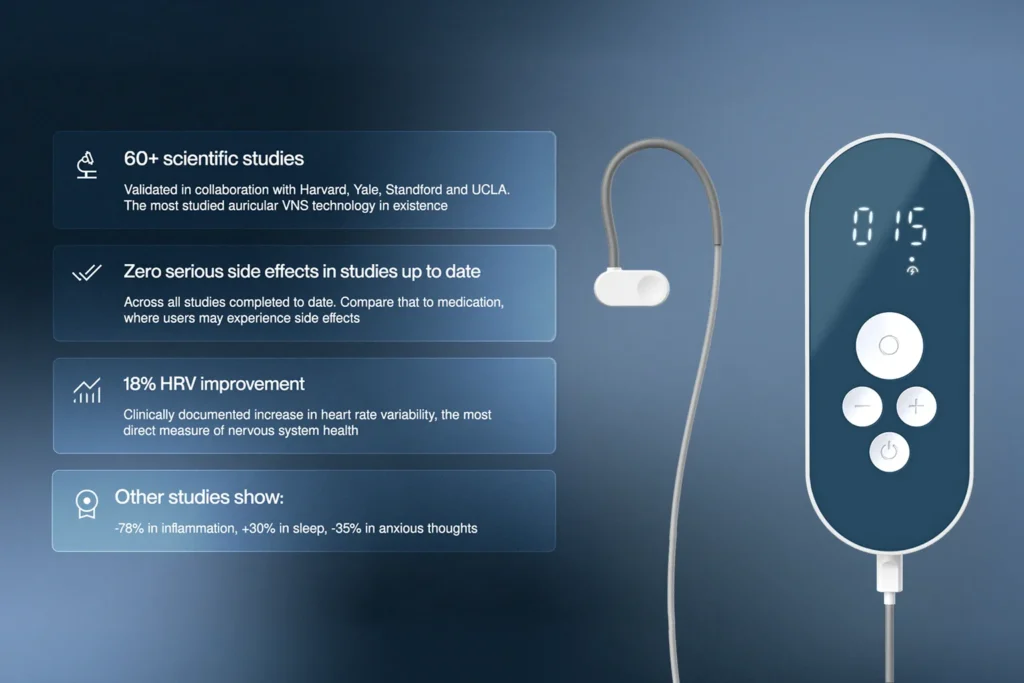
As I dug deeper, the research behind Nuropod appeared substantially more device-specific than what I usually see across most consumer wellness products – explored alongside institutions including UCLA, Imperial College London, Harvard-affiliated research groups, and the NHS.
Finding Nuropod was one thing. Taking it seriously was another.
There are countless products promising calm, balance, recovery, and better sleep. Most I don’t look at twice.
But Nuropod kept pulling me back – because it was one of the first nervous system approaches I had seen that did not depend on people first finding the focus and mental space they had already run out of.
In simple terms, Nuropod gently stimulates a branch of the vagus nerve through the ear, supporting the body’s shift out of prolonged stress activation and back toward a calmer parasympathetic state.
Thirty minutes. Clipped to the ear. While you are doing something else entirely.
What People Are Noticing
Most accounts I have come across are not describing dramatic overnight transformations.
What many people seem to notice first is much quieter than that:
- Feeling less reactive during ordinary moments
- More mental space between one thing and the next
- Fewer racing thoughts once the day finally becomes quiet
- A sense that the mind is no longer constantly scanning for the next problem the moment everything goes still
And for people who have spent months – sometimes years – feeling mentally on edge, even small shifts like that can start to feel surprisingly meaningful.
Because most people are not trying to become perfectly calm all the time.
They simply want to sit down at the end of the day without immediately feeling like their brain is still at the office.
Research around vagus nerve stimulation has also explored improvements connected to fatigue, HRV, stress resilience, sleep, and nervous system regulation with continued use. That does not mean every person experiences the same results. But it does help explain why so many people have become interested in using it consistently.
Why I Don’t See This As A Replacement For Therapy Or Real Recovery
I always want to be careful not to oversimplify.
No device replaces sleep, therapy, emotional support, nutrition, boundaries, or medical care. Real recovery is layered:
- Sometimes therapy helps address deeper patterns
- Sometimes people need more rest or stronger boundaries
- Sometimes people need support processing difficult experiences
- More often, it is a combination of several things
But during overwhelming periods – particularly for people whose days leave very little room for the kind of careful, consistent effort most stress routines require – many people also need something practical. Something that fits inside real life instead of demanding they escape it first.
That is where I think tools like Nuropod may become genuinely useful – not as a replacement for the basics, but as one additional layer of nervous system support during periods of chronic stress, anxious thoughts, poor sleep, and that constant feeling of being permanently on.
And while I noticed this pattern most clearly in people with demanding desk-based jobs and long working hours, the same nervous system dynamic shows up across very different lives – carers, people going through difficult periods, anyone carrying sustained pressure without enough genuine recovery in between.
Whatever You Are Carrying Right Now Is Just A Bump In The Road
Something I find myself saying often is this: your life is like a long road, and whatever you are carrying right now is just a bump in that road. Not the whole journey.
Many people spend years believing there is something fundamentally wrong with them. In reality, they are often experiencing very understandable responses to difficult circumstances, sustained pressure, and a nervous system that learned – reasonably, sensibly – to stay alert.
Your nervous system may simply have spent too long receiving signals of demand, responsibility, and constant mental activity – without enough moments that truly felt calm, safe, or restorative.
And after enough time living like that, many people stop remembering what genuine calm is even supposed to feel like.
That does not mean there is something wrong with you.
It may simply mean your nervous system needs more consistent signals that it is safe to stop.
The goal is not becoming perfectly peaceful all the time. That is not real life.
The goal is smaller than that – but often much more meaningful:
- To feel less braced at the end of the day
- Less like your mind is still at the office long after you left
- Less like you are permanently waiting for the next thing to go wrong
And for some people – particularly those who spend their days at a desk, carry work home mentally even when they have physically left, and find their mind still running long after it should have stopped – a small daily habit like Nuropod may become one realistic way to support that shift.
Without needing to find another hour. Another perfect routine. Or another version of themselves who somehow has everything under control.
This blog post aims to be informational and should not replace professional health advice. Always consult with a health professional for personalised advice.