
It has been covered by the BBC, the Guardian and Scientific American. Bryan Johnson wears one. It has been through 60+ completed scientific studies. So why has almost nobody heard of it?

Your bloodwork came back normal.
- Thyroid, fine.
- Iron, fine.
- B12, fine.
- Inflammatory markers, unremarkable.
And you still woke up this morning feeling like you’d been hit by a truck.
If you’ve been told “everything looks good” while feeling anything but, you already know how isolating that sentence is. It leaves you with two explanations, and neither is kind: either it’s in your head, or you’re just not trying hard enough.
There is a third explanation and what you will read will probably surprise you.
It’s not in your blood.
It’s in a nerve, one that runs from your brainstem to nearly every major organ you have, and that no routine physical ever tests.
Exhaustion has been treated as a fuel problem. It may be a brake problem.
For decades, tiredness has been approached the same way: something is missing.
Not enough sleep, not enough iron, not enough discipline.
Add fuel, restore energy.
But your body doesn’t only have an accelerator. It has a brake, and researchers now think the brake is where a lot of chronic exhaustion actually begins.
Your autonomic nervous system runs on two settings.
- The accelerator: the sympathetic nervous system, which is the fight or flight mode: Heart rate up, cortisol up, muscles primed, digestion suppressed. It works brilliantly in an emergency.
- The brake: the parasympathetic nervous system, which is the rest and digest. This is the setting where your body actually repairs itself: where inflammation resolves, tissue rebuilds, and deep sleep happens.
The main cable running that brake is the vagus nerve.
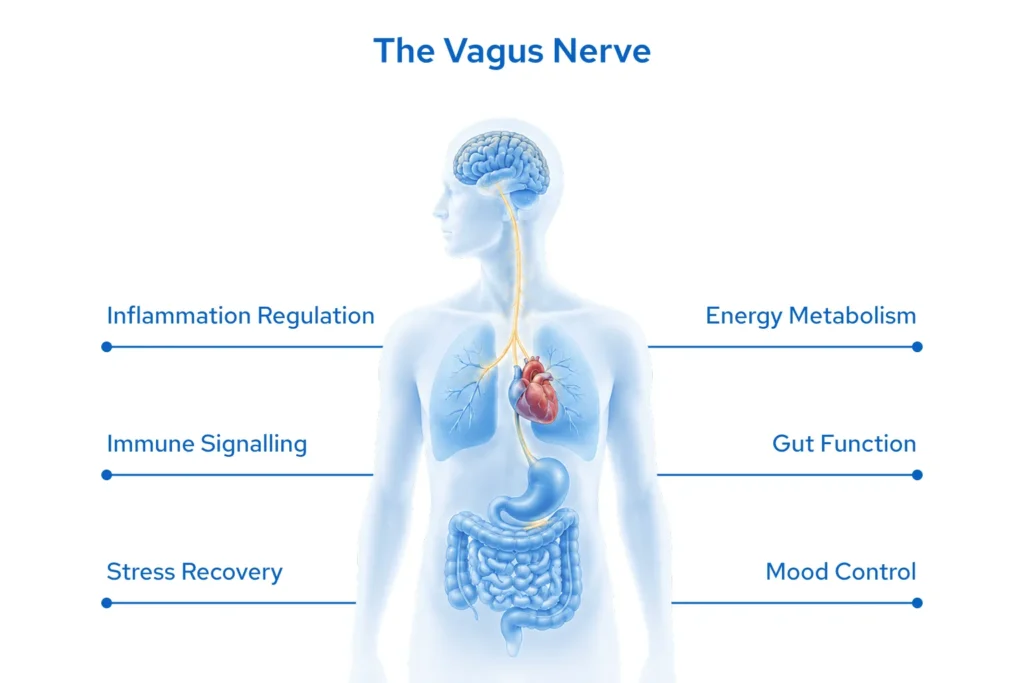
Here’s the problem:
The accelerator is extremely easy to press: deadlines press it, notifications press it, bad sleep presses it, grief presses it, a virus you had two years ago presses it. And when it’s held down long enough, the brake begins to lose its grip.
Researchers have a name for that: low vagal tone.And when the vagal tone is low, something counterintuitive happens.
You can sleep eight hours and still not recover.
Because sleep isn’t recovery… Sleep is the opportunity for recovery. Your parasympathetic system is what does the actual work. If it never fully switches on, you spend the night resting without repairing it.
So you wake up tired.
You reach for coffee.
And the accelerator goes down again.
The inflammation loop nobody mentions
There’s a second consequence, and it may be the more important one.
The vagus nerve is also one of the body’s primary brakes on inflammation, a mechanism scientists named the cholinergic anti-inflammatory pathway. When vagal signalling weakens, low-grade inflammation runs unchecked.
And inflammation is exhausting.
It’s the same machinery that flattens you for three days when you have flu, turned down to a permanent hum you never quite notice, because you’ve had it so long you think it’s just how you are now.
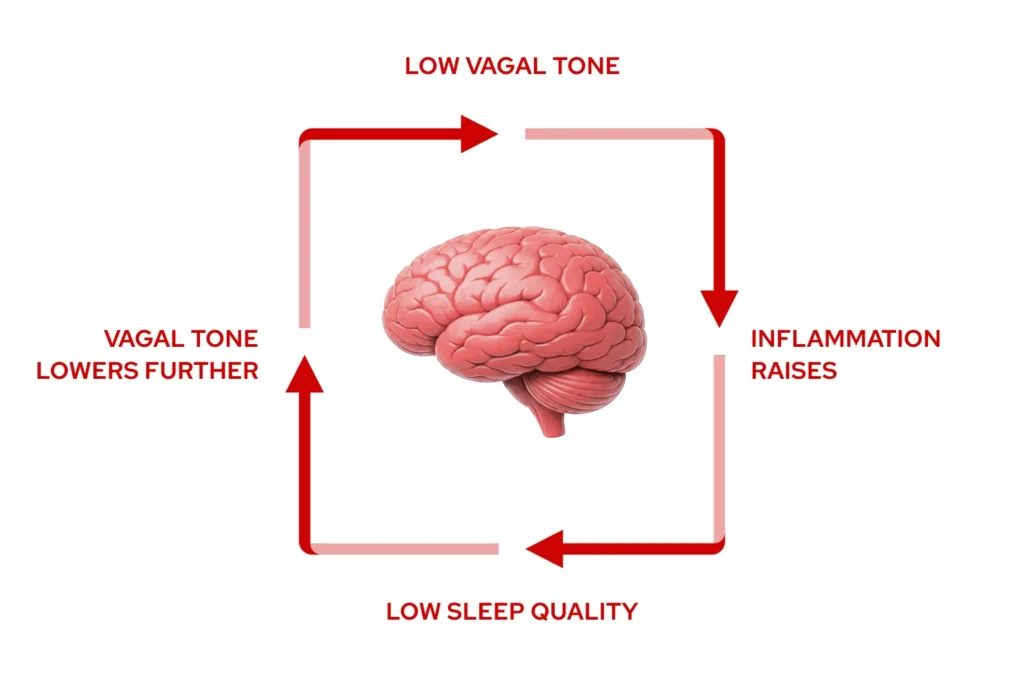
Low vagal tone raises inflammation, inflammation degrades sleep quality and poor sleep lowers vagal tone further.
That’s not a symptom, that’s a loop.
And loops don’t resolve on their own.
Why the usual advice keeps failing
Once you see tiredness as a brake problem instead of a fuel problem, the standard advice starts to make a lot more sense.
Specifically, why so little of it works.
- More sleep doesn't help, because the issue was never sleep quantity.
- Caffeine doesn't help, because it presses the accelerator harder into a system that's already stuck on.
- Iron and B12 don't help, if your levels were never low to begin with. That's what "normal bloodwork" means.
- Exercise helps some people and wrecks others, because for a dysregulated nervous system, hard training is one more stressor on the pile.
- Cold plunges, breathwork, meditation…These actually do influence vagal tone, which is precisely why some people swear by them. But they're indirect, inconsistent, and they demand something you don't have: the energy to do them daily.
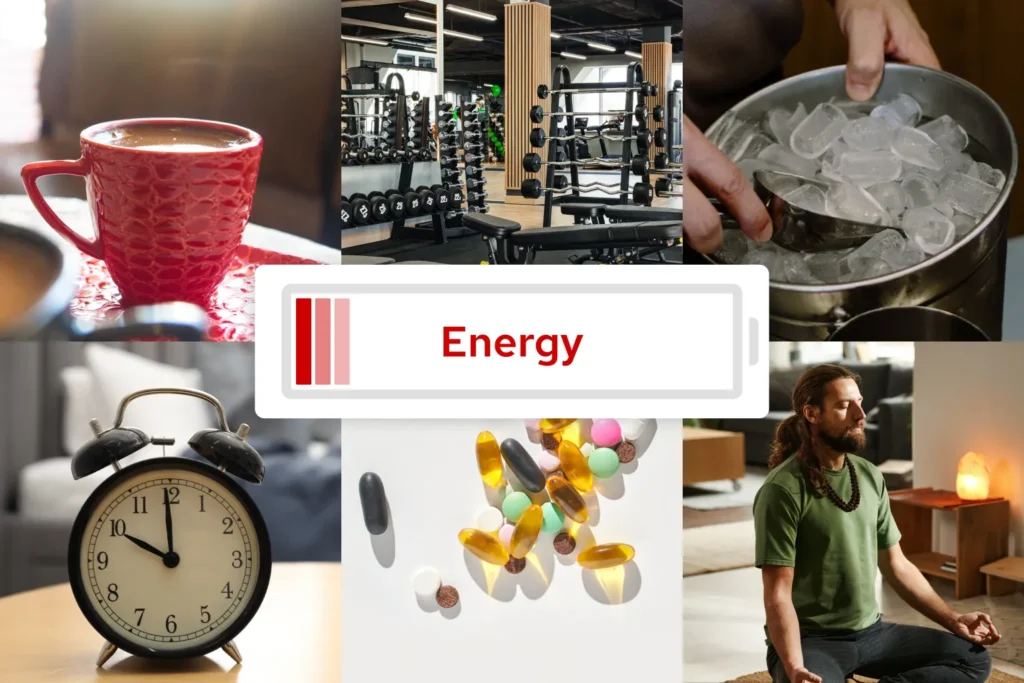
You’ve been trying to refill a tank that was never empty.
So can you press the brake directly?
That question is not new.
Health professionals have been stimulating the vagus nerve deliberately since the 1990s, and surgically implanted vagus nerve stimulators are an established solution for therapy -resistant depressive states.
They work, but they also require surgery, and a device implanted in your chest.
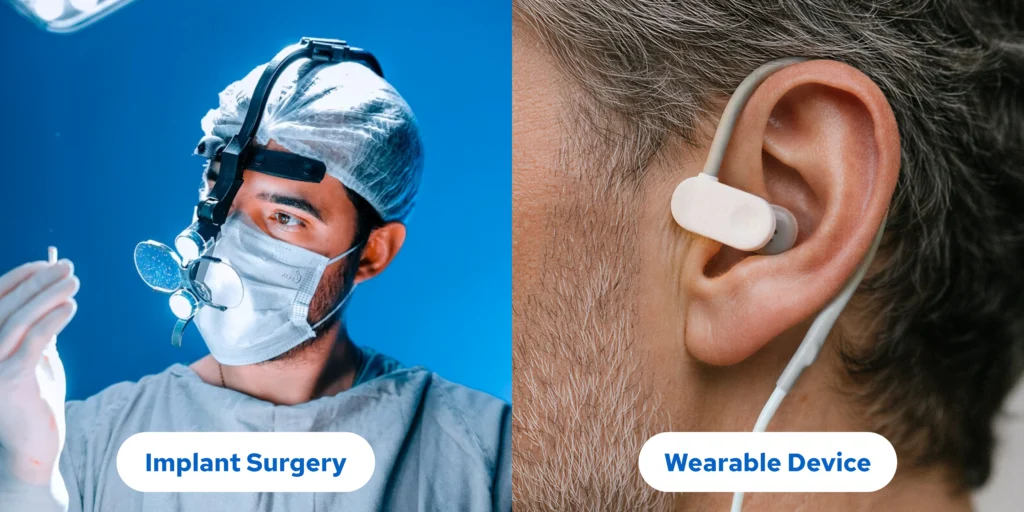
But the big shift came from anatomy.
There is one place on the human body where a branch of the vagus nerve runs close enough to the skin to be reached from the outside: a small flap of cartilage at the entrance of your ear called the tragus.
Clip an electrode there, send a precisely tuned electrical signal, reach the same nerve, without cutting anyone open.
The field has a name now: non-invasive vagus nerve stimulation, or neuromodulation. And over the past few years it has moved out of research labs and into serious mainstream coverage.
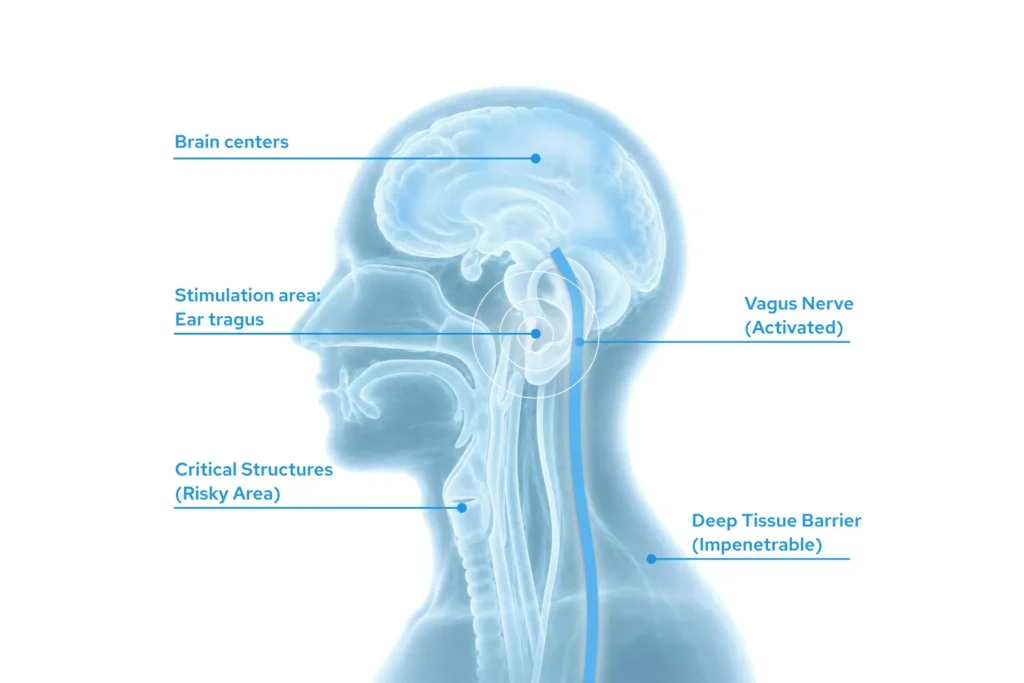
A team of London scientists developed a way to stimulate that nerve
And that way?
It’s called Nuropod, and it’s the wearable most of that research runs through.
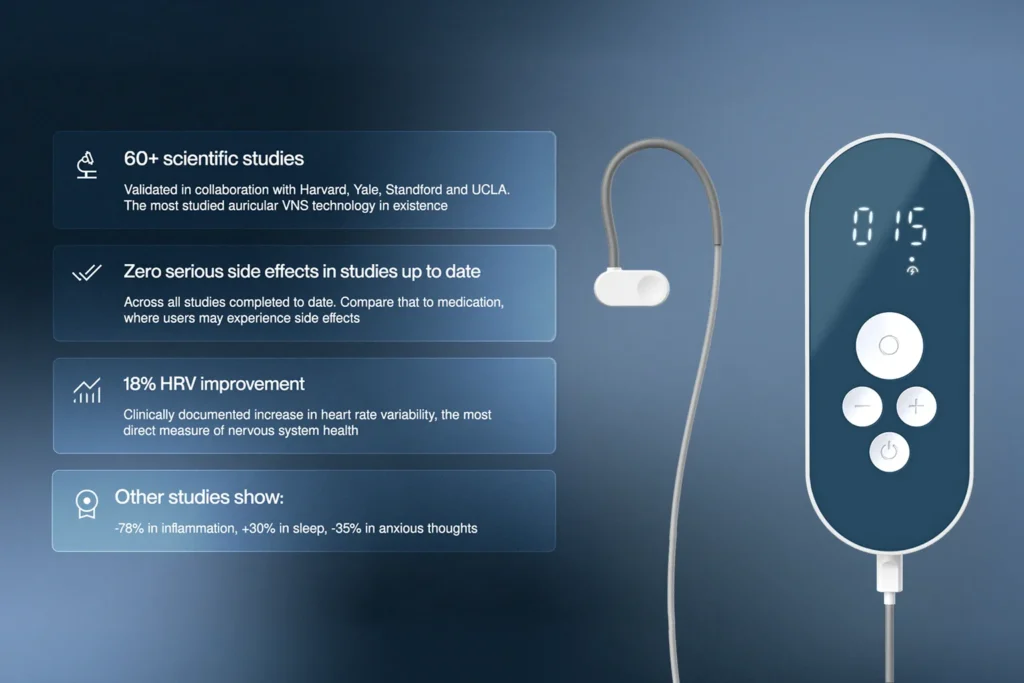
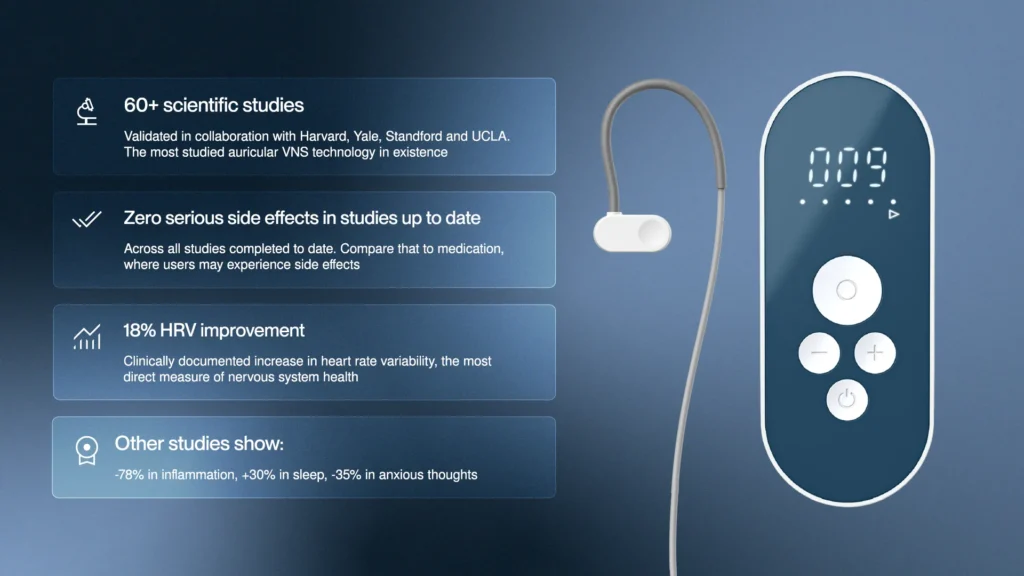
It’s made by Parasym, a London-based neurotech company, and it’s small enough to be unremarkable: an earpiece that sits on the tragus like a discreet headphone, connected to a controller about the size of a car key fob.
You wear it for 15 to 60 minutes a day: reading, working, on the sofa, before bed. When it’s active you feel a light tingling on the ear.
That’s it.
You do not need app rituals, supplements, or appointments.
Behind that simplicity is roughly a decade of work: over $10 million invested in research and development research, 60+ completed studies, and partnerships with more than 150 research institutions all over the world. The team behind the device reports more than 5 million completed user sessions and zero serious adverse events across its studies conducted up to date.
It is, by a fairly wide margin, the most studied non-invasive vagus nerve stimulation system in the world.

What the studies found
Across those completed studies, participants recorded:
Measure | Result |
Tiredness | 48% reduction |
Vagus nerve activity | 61% improvement |
Heart rate variability | 18% improvement |
Inflammatory markers | 78% reduction |
Sleep | 30% improvement |
Post-viral symptoms | 61% reduction |
Results were recorded in specific study populations. Individual results will vary.
Two findings stand out for anyone whose main complaint is exhaustion.
The first: in a controlled study, a single one-hour session significantly improved every measured parameter of heart rate variability compared to placebo. HRV is the standard non-invasive proxy for vagal tone, the closest thing science has to a dashboard reading of your recovery capacity.
The second, and the more interesting one:
Participants reported sustained improvement a full week after they stopped using it. That points to something more than a temporary effect while the current is on. It suggests the nervous system may be relearning where its baseline sits.
The underlying research has been published in peer-reviewed journals including the Journal of the American College of Cardiology, the Journal of the American Heart Association, Brain Stimulation, and Frontiers in Neurology.

What people actually say
Nuropod has been adopted by over 1,200 independent clinicians who use or recommend it in practice.

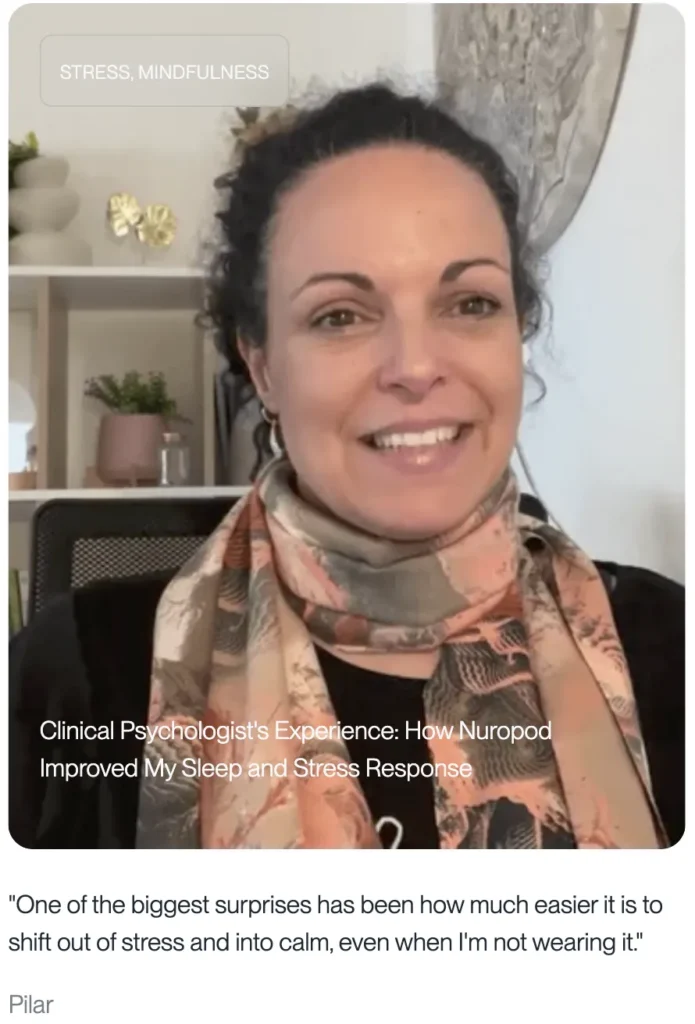
And from users:
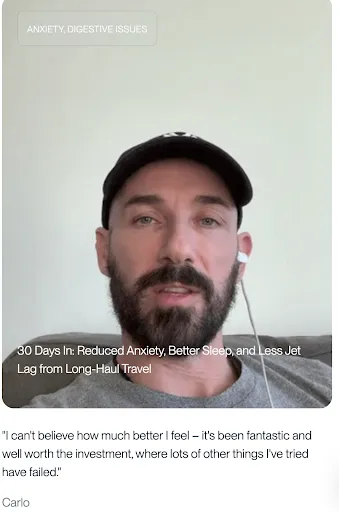
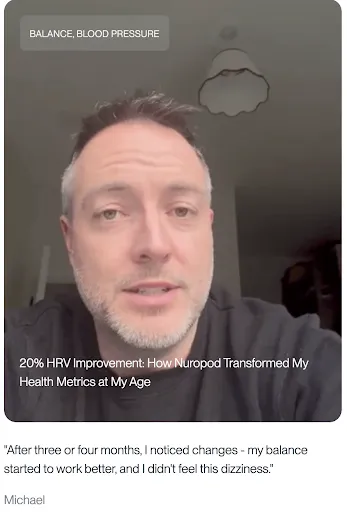

What it’s honestly like
It’s worth setting expectations properly, because the people this helps most are the people who’ve already been disappointed several times.
1. It is not a stimulant.
There is no hit, no lift, no buzz. Most people describe the change as noticing, two or three weeks in, that they got through an afternoon without needing to lie down.
2. It is not instant.
Some users report changes within about five days. For others it takes several weeks of consistent daily use.
3. It requires a daily habit.
Fifteen minutes a day, most days. That’s the whole ask, but it is an ask.
4. It is not a cure for anything.
Nuropod is a wellness device. It is not intended to diagnose, treat, or prevent any disease, and it is not a replacement for medical care. If you’re exhausted, get properly investigated first.
The honest part about the price
Nuropod is $900. That is not an impulse purchase and it shouldn’t be treated as one.
But here are a few things that are worth weighing against it.
It’s a device, not a subscription. Nuropod has been built for years of daily use, with no refills and nothing to reorder. Over two years, that’s a little over a dollar a day.
And there’s a 30-day money-back guarantee. Returns are accepted up to 37 days from the order date. If nothing changes in a month, you’re out nothing but the effort.
Most people reading this have already spent more than $900 on supplements, sleep gadgets and specialist appointments that changed nothing.
So where does that leave you?
You have been treating exhaustion as a fuel problem for years or possibly decades.
More sleep, another supplement, another round of blood that comes back normal.
If the fuel was never the issue, none of it was ever going to work.
The question worth asking is not “what else can I take.”
It is whether your brake still works.
And unlike most things you have been told about tiredness, that is a question you can actually answer.
Two ways to find out
Option one: find out where you stand, free.
Parasym’s clinical team built an assessment that scores nervous system function across ten areas: tiredness, sleep, digestion, immune response, stress recovery and others.
It takes under five minutes. At the end you get a score and a plain reading of whether low vagal tone is likely to be part of your picture, or whether something else is going on.
If it is not your problem, it will tell you that, and you will have lost five minutes.
Option two: skip the questions and test it on yourself.
If you have read this far, you probably already recognise the pattern. In that case the assessment is a detour.
What you actually get
The Nuropod kit. Controller, earpiece, charging cable, carry case, and a quick start guide. Nothing to reorder, no subscription, no consumables.
A guided first month. Emails through the early weeks with protocol adjustments, intensity guidance and troubleshooting. Most people who abandon a device like this do it in week one because they cannot find the right setting. This is the part that stops that happening.
Human support that actually answers. Parasym replies to the overwhelming majority of complaints on public review platforms, including the negative ones, and replaces faulty earpieces under warranty. That is not a small thing on a $900 device you are buying from a website.
Two-year warranty on the main unit.
30 days to decide. Use it daily for a month. If nothing shifts, request a refund. The window opens on your order date and closes 37 days later.
HSA/FSA eligible through Truemed. For US buyers this means paying with pre-tax dollars, which depending on your bracket takes a meaningful amount off the real cost.
The last three questions people ask
“What if it doesn’t work for me?”
Then it doesn’t, and you send it back.
Being straight about it: this does not work for everyone. Parasym’s own public reviews include people who used it daily for a month and felt nothing at all. Any page that tells you otherwise is lying to you.
What the 30-day window does is move the risk off you. You are not betting $900 on whether it works. You are spending thirty days finding out.
“Isn’t this just an expensive TENS machine?”
A TENS unit pushes a general current into muscle tissue to interrupt pain signals. It is not aimed at anything in particular.
The claim here is narrower and more testable: a specific waveform, at a specific site, targeting a specific nerve branch, measured against a placebo device in randomised controlled studies. Whether that justifies the price is your call. But it is a different claim, and it has been tested as one.
“Is it safe?”
It carries a CE mark in the EU. Across the studies run to date, no serious adverse events have been reported. It is non-invasive, there is no surgery, and you can stop at any point.
If you have a pacemaker or another implanted electronic device, or you are pregnant, check with your health professional first.
One thing worth saying plainly
There is no countdown on this page. No stock counter, no expiring cart.
But there is a real cost to waiting, and it is not a marketing one.
The loop this article describes does not sit still. Low vagal tone raises inflammation. Inflammation degrades sleep. Poor sleep lowers vagal tone further. Every month it runs unchallenged is a month it gets slightly more established.
You have spent long enough proving that rest alone does not break it.
30-day money-back guarantee. HSA/FSA eligible.
P.S. You do not have to believe any of this.
That is the point of the thirty days. Clip it on for fifteen minutes a day, for a month, and see whether you get to four in the afternoon without needing to lie down.
If you don’t, you send it back. If you do, you will have found the thing that eight years of normal bloodwork never showed you.
Nuropod is a wellness device manufactured by Parasym Scientific. These statements have not been evaluated by the Food and Drug Administration. This product is not intended to diagnose, treat, cure or prevent any disease. Always consult a health professional. Study results reflect specific study populations; individual results will vary. Testimonials reflect individual experiences and are not typical results. This page is a paid advertisement.