I’ll be honest with you.
I coach recovery for a living, and for weeks my own HRV (Heart Rate Variability, a measure of how well your autonomic nervous system is recovering) had been sitting lower than it should.
I’m a fitness coach. I’ve spent over a decade building training programs, and I tell every client the same thing: your workouts don’t make you fitter. Your recovery does. The session breaks you down. What happens after decides whether you actually improve.
So when my own number stayed low, I did what I’d tell a client to do. I looked at the obvious cause first: training volume. I backed off. An easier week. An extra rest day.
It didn’t come back.
I was training well, eating well, sleeping reasonably, and sessions that used to feel manageable were leaving me flat the next day. That tired-but-wired feeling, wound up but drained at the same time, had become more the norm than the exception.
That’s what led me to try Nuropod for 30 days, tracking what actually changed, not what I expected to change. Here’s what the data showed, including the part I didn’t see coming.
What I Was Already Doing, And Why It Wasn't Enough

I didn’t come to this without a recovery routine already in place.
Sleep, protein, hydration, the basics. Already dialed in as well as I can manage with two kids and a full coaching schedule.
Foam rolling and stretching after sessions. Genuinely helpful for how my body feels, but it does nothing for the part of me that still feels wound up hours later.
Breathwork before harder sessions. Works well, box breathing especially, but doing it justice takes a few uninterrupted minutes, and those are in short supply on the mornings I need it most.
What I kept noticing was that all of these approaches asked something of me before they’d work: time, quiet, enough bandwidth to actually do them properly. On the weeks I needed recovery support the most, those were exactly the weeks I had the least of any of that to give.
The autonomic nervous system has two primary branches: the sympathetic (drive, output, training stress) and the parasympathetic (rest, digestion, recovery). Hard training increases sympathetic activity. Recovery involves the body’s ability to shift back toward parasympathetic activity afterward.
I wanted something that supported that shift directly, not something that asked me to carve out more time I didn’t have.
Why I Was Skeptical, And What Changed That
As a coach, I use HRV data, mine and, where clients track it, theirs, to adjust a session or back off a day. One low reading means nothing. A pattern is different, and mine had lasted weeks.
An ear clip that’s supposed to support that recovery signal directly sounded, honestly, like most things that land in my inbox. Most of them lean hard on HRV and sleep claims without much behind them.
What made me look closer was that this wasn’t just general vagus nerve talk. A 2025 randomized trial out of UCL and Queen Mary University London had 28 healthy volunteers use this kind of ear stimulation for 30 minutes daily over 7 days, and found a measurable increase in peak oxygen uptake and peak work rate compared to a sham group.¹ Modest, in untrained volunteers over one week, and not proof it transforms an athlete’s performance. But it’s real trial data, not a wellness claim.
So I set it up as a test.
Days 1-4: First Impressions
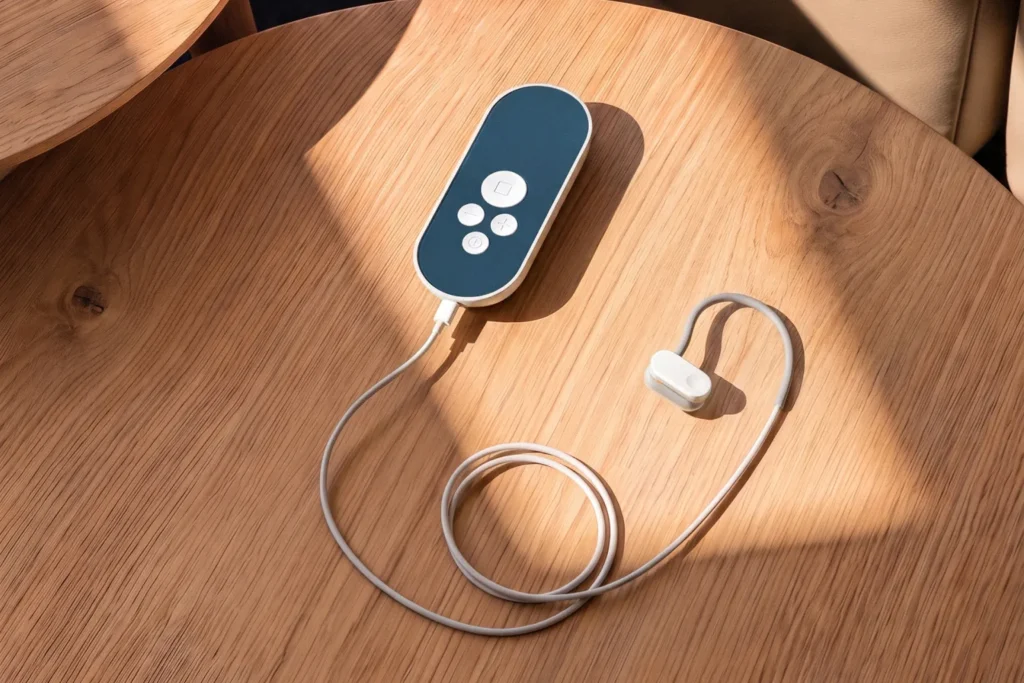
The device is smaller than I expected. Clips to the outer ear, small wire down to a control unit. No app, no gel, nothing to set up. I used it post-workout, during my cooldown, and again in the evening. The sensation is a light tingling that barely registers after a few minutes.
Days 1 and 2, nothing dramatic. Recovery adaptations don’t show up in 48 hours, and I wasn’t about to pretend otherwise. By day 3 or 4, post-workout, I noticed my legs felt less heavy on the walk back to the house than they usually do after that kind of session. Small. Easy to dismiss. I paid attention anyway.
Days 8-14: A Different Kind of Recovery Week
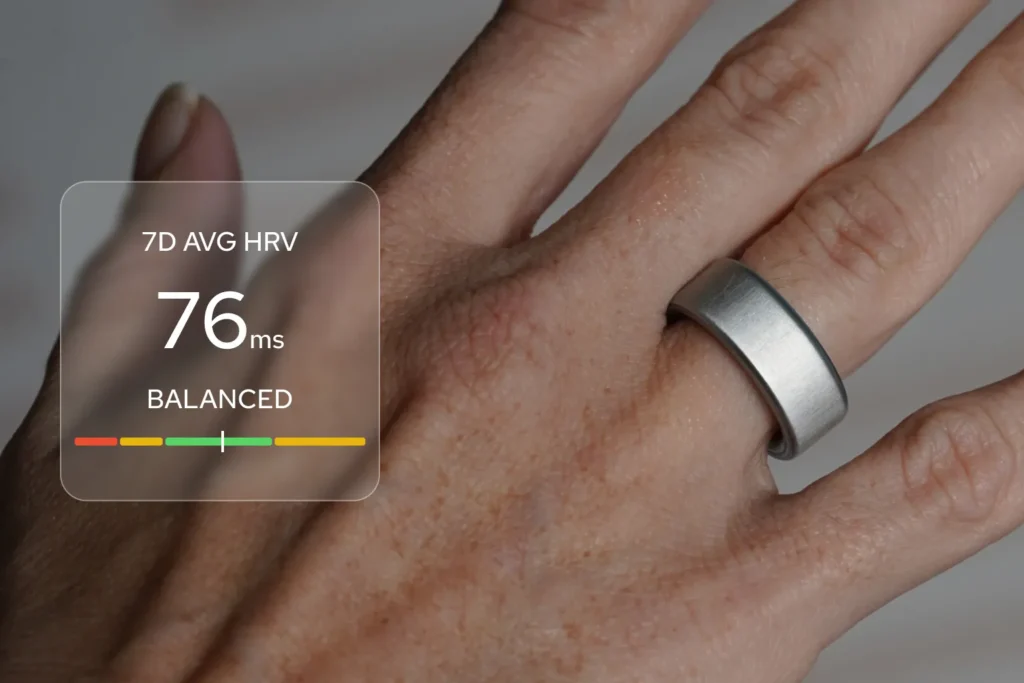
By day 8, I was using it consistently, post-workout and again in the evening.
My HRV began trending up. Not a dramatic jump, a gradual climb.
Then I hit a properly demanding training week, back-to-back harder sessions with a full coaching schedule on top. The kind of week that would normally leave me flat by Friday, HRV down, sleep worse, patience shorter.
It dipped, the way a hard week does. But it came back sooner than it usually would, instead of staying suppressed most of the following week.
Mid-week, I had a heavy training session followed by a full afternoon of back-to-back client sessions, barely a break between them. I used the device for 20 minutes in between. I finished that day tired, honestly, but not the flattened, can’t-think-straight kind of tired I’d expect.
Days 15-30: What Changed Between Hard Sessions
The clearest shift showed up in how I recovered between hard sessions.
Before, a demanding training week meant a few days of feeling flat before I trusted my body to push again. That window started shortening.
My easy sessions started feeling easy again, the pace that had felt like a grind on tired legs settled back into something aerobic instead of effortful.
Sleep played a role too, and it’s the part I trust most, more than any single HRV reading. My sleep quality improved on the weeks I used the device most consistently, downstream of the same recovery signal I was trying to support.
I still get tired after hard sessions. That’s the job, training is supposed to create fatigue. What changed is how efficiently I came back from it.
What the 30 Days Showed Me About My HRV
When I lined my 30 days up against the weeks before, my HRV didn’t follow my training the way I’d assumed it would.
The easier weeks I’d taken before I started hadn’t brought it back, and the hard sessions weren’t what set the pattern during the 30 days either. What stayed constant was everything that isn’t training: a full coaching schedule, two kids, life admin. Even on my rest days, my nervous system was still running.
The house finally goes quiet, and my brain starts up again: school tomorrow, the permission slip, whether a kid’s temperature was really normal. That isn’t rest. It’s a second shift that never shows up in a training log.
That’s my pattern in my data, not a rule for everyone, and one month of tracking can’t separate every variable. But it changed the question. I stopped asking how to train less and started asking how to help my nervous system come down from a day that doesn’t stop.
That’s where the device made sense to me: not as a fix for my training, but as support for the part of the day I couldn’t schedule around. Fifteen minutes in the evening, folding the kids’ laundry, instead of one more thing on the list.
Day 30: What Changed, And What Didn't
What didn’t dramatically change: this isn’t a substitute for actual recovery practices. I still prioritize sleep, still eat to support training, still build easier weeks into my programming. The device didn’t replace any of that.
What did change:
- My HRV trended up overall, and more importantly, recovered faster after hard training weeks instead of staying suppressed
- I stopped treating a low HRV as a training problem
- The window between a hard week and feeling ready to push again got shorter
- Sleep quality improved on the weeks I used it consistently
The shift wasn’t overnight, and it wasn’t dramatic in any single session. But it showed up consistently, in the weeks that actually tested it.
Why It Works: HRV, Fatigue and Sleep
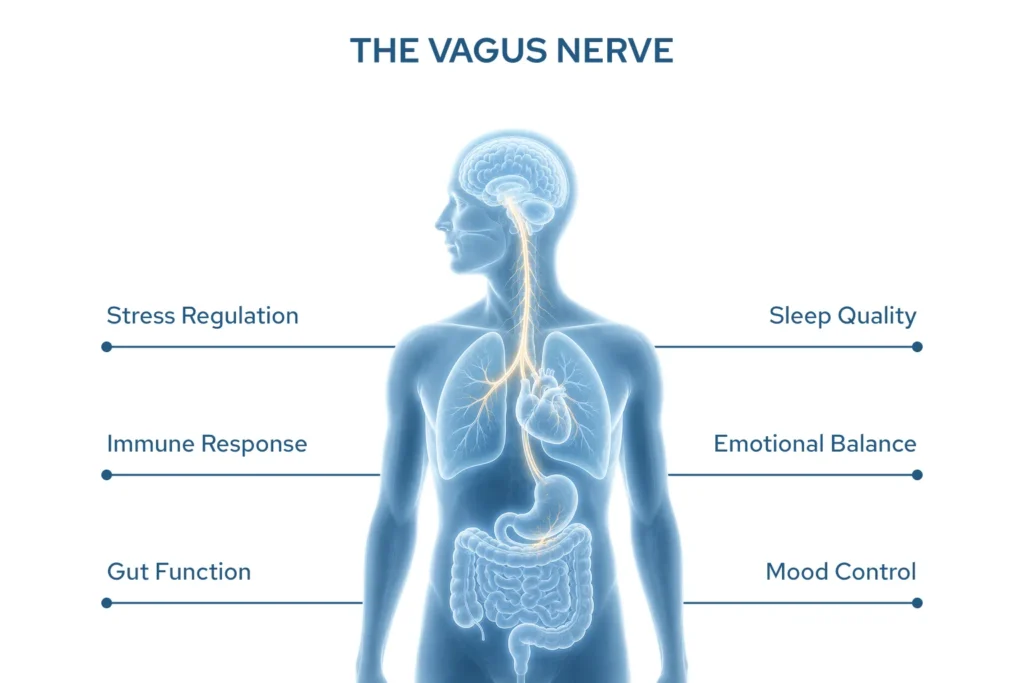
The vagus nerve is the body’s primary parasympathetic pathway, involved in shifting the body out of a stressed or trained-hard state and toward recovery. HRV is better understood as a marker of autonomic flexibility: how well your body responds to demand and then returns toward recovery. It’s not a direct recovery score on its own, but it’s one of the more accessible signals available.
taVNS (Transcutaneous Auricular Vagus Nerve Stimulation) reaches the vagus nerve through its auricular branch, the only place it surfaces at the body’s exterior, at the outer ear. Nuropod uses AVNT™ (Auricular Vagal Neuromodulation Technology), designed to support parasympathetic activity through this branch.
That’s worth being precise about: the research shows taVNS can influence HRV and related autonomic markers.² ³ It’s a different, narrower claim than saying it boosts athletic performance outright, and I’d rather undersell that than oversell it.
10+ years of R&D, 60+ completed studies, 150+ internationally recognized research institutions.
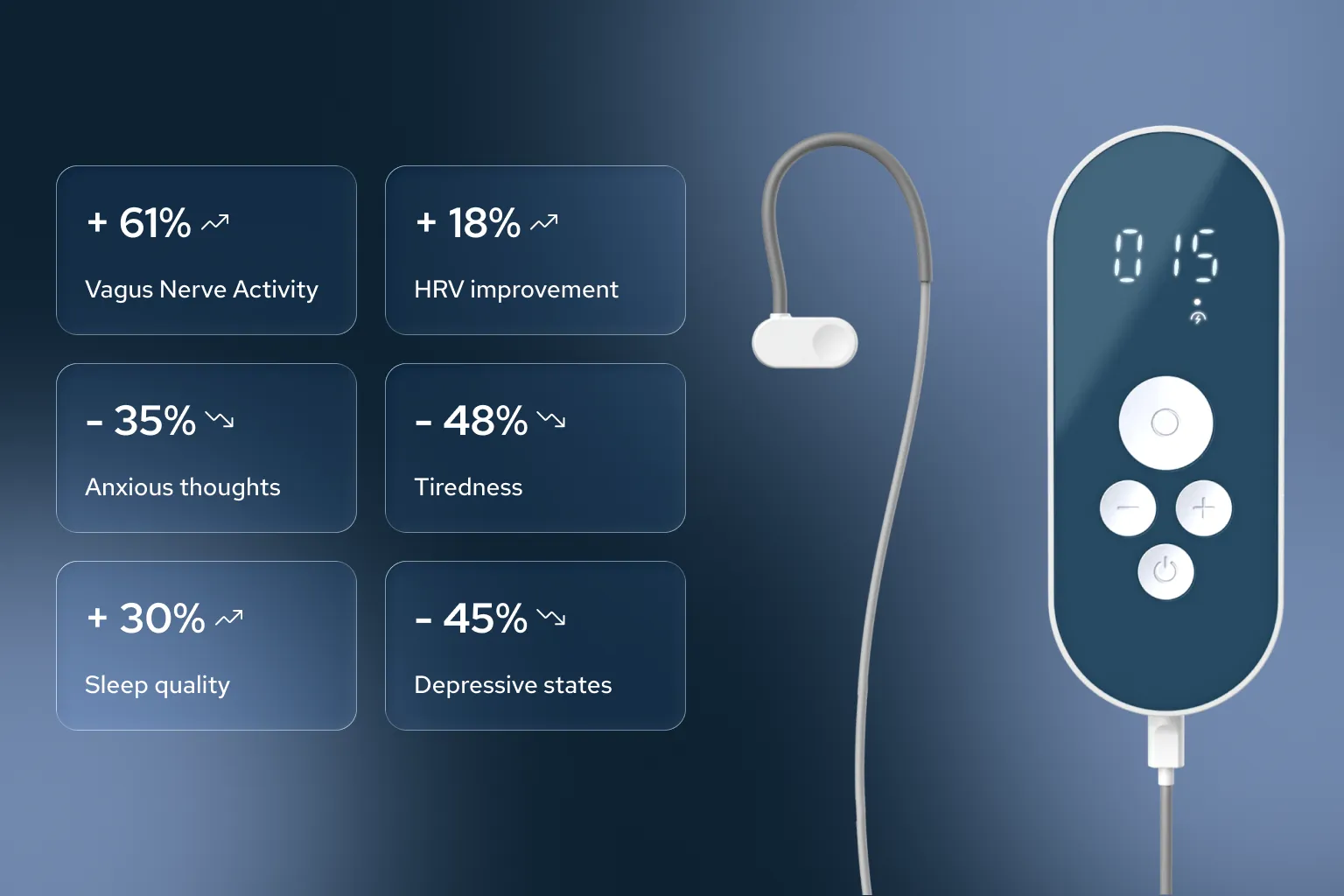
Results from peer-reviewed studies in specific study populations. The sleep and fatigue figures come from studies in Long COVID and post-viral syndrome patients.
What Using It Actually Looks Like Day to Day
Cost: ~$900. Guarantee: 30-day money-back, no questions asked. Setup: Clips to ear. No app. No gel. No prescription. Wired, not wireless. Sessions: 15 minutes minimum. I do it post-workout and again in the evening. Battery: Over a month per charge.
You can use it while:
- Cooling down post-workout
- Reviewing client programming
- Folding the kids' laundry
- Meal prepping
- Reading before bed
Your Garmin or Oura can show you the pattern. Nuropod is designed to support parasympathetic activity directly, without adding another time-consuming recovery routine.
Pros and Cons
✅ Pros:
- World's most studied wearable VNS system
- Trusted by 1,000+ licensed healthcare professionals
- No app, no gel, no prescription
- 30-day money-back guarantee
❌ Cons:
- ~$900 upfront cost
- Results build gradually, not a day-one fix
- Wired, not wireless
- Only available online
Who Should Try This
Worth it if:
- You track HRV, sleep, or a readiness score and it stays low even after you've backed off training
- Your life outside the gym, work, kids, life admin, is as demanding as the training itself
- Your easy sessions stopped feeling easy
- You've tried the standard recovery tools and found them hard to fit into an actual training and coaching schedule
- You coach others on recovery and, like me, have been slower to apply it to yourself
Skip it if you want instant results or a replacement for sleep, nutrition, and actual training periodization. This works alongside those things, at the level underneath them.
Do not use if you have an implanted cardiac device, are pregnant, have had a serious cardiac event in the last five years, or are under 18. Always consult a healthcare professional first.
My Verdict
I came into this skeptical, the way I come into most recovery products, looking at the pattern rather than how something felt on day one.
What changed my mind wasn’t one good HRV reading. It was how much faster I came back after the weeks that used to knock me flat, and what that showed me about how my recovery actually works.
As a coach, that’s what matters. Not a single number, but how quickly you come back.
That’s why I’m still using it.
EXCLUSIVE OFFER FOR OUR READERS: Get 5% Off Nuropod From Our Editorial Team!
References:
- Ackland GL, et al. Non-invasive vagus nerve stimulation and exercise capacity in healthy volunteers: a randomized trial. European Heart Journal. 2025;46(17):1634-1644. https://doi.org/10.1093/eurheartj/ehaf037
- Geng D, et al. The effect of transcutaneous auricular vagus nerve stimulation on HRV in healthy young people. PLoS ONE. 2022. https://doi.org/10.1371/journal.pone.0263833
- Soltani D, et al. Effects of taVNS on HRV: systematic review. Clinical Autonomic Research. 2023. https://pubmed.ncbi.nlm.nih.gov/37119426/
- Dolcini J, et al. Effects of taVNS on sleep quality and widespread pain: randomized controlled trial. Peer-reviewed clinical data, Parasym Ltd. 2025.
- Verbanck P, et al. Effects of taVNS on tiredness and fatigue scores. Peer-reviewed clinical data. 2021.
This article reflects my personal experience and professional evaluation of the evidence. This article is published in partnership with Nuropod. I may receive compensation from purchases made through links in this article. This is not medical advice, always consult a healthcare professional before starting any new health intervention. Individual results may vary.