
You Do Everything the Sleep Advice Says. You Still Wake Up Tired.
You black out the room. You keep a consistent schedule where the shift pattern allows it. You’ve cut the screen time, tried the melatonin, done the things every sleep hygiene checklist recommends.
And some nights, none of it seems to matter.
You fall asleep fine and wake at 3am fully alert for no obvious reason. Or you get a full night, technically, seven or eight hours, and still don’t wake up feeling like anything was repaired overnight.
For people working rotating, night, or on-call shifts, this pattern is especially familiar. Nursing. Emergency medicine. Anesthesia. Any speciality built around irregular hours.
If you’ve done what the sleep hygiene advice recommends and it still isn’t helping how you feel in the morning, that’s not a failure of discipline.
For years, poor sleep has been explained almost entirely as a hygiene problem. Wrong environment. Wrong habits.
And those things do matter.
But here’s what doesn’t get said enough: for a lot of shift-based healthcare professionals, the problem isn’t always just too little sleep. It’s also how effectively the nervous system shifts out of alert mode when the opportunity to sleep finally comes.
So what’s actually going on?
What I Keep Finding When I Review Research on Healthcare Professionals

I was training as a surgeon. I did my internship in general surgery at the Mayo Clinic, and partway through my training, I stepped away from the operating room. Not because I stopped caring about the work. I wasn’t sure I wanted to spend as many as ten hours a day in the OR for the rest of my career, and I felt I could create value outside the confines of a hospital too. That’s what pulled me toward public health instead.
I moved into public health, focusing on health economics. I’m now in the business of healthcare, where I provide strategic advice to companies creating meaningful tools that can improve people’s lives. Among other things, I also peer-review health economics research for the British Medical Journal, and I continue to publish scientific research in collaboration with different teams. That means I spend a meaningful part of my week reading scientific studies closely enough to know which findings actually hold up.
One pattern shows up repeatedly in the sleep medicine literature, and it rarely makes it into the advice healthcare workers are actually given. Sleep hygiene interventions address the environment and the behaviors that build sleep pressure, the drive to sleep that accumulates over the day. They don’t necessarily address what happens underneath both of those: whether the nervous system is efficiently shifting out of alert mode once the opportunity for rest arrives.
When You’re Doing Everything Right, But Sleep Still Doesn’t Restore
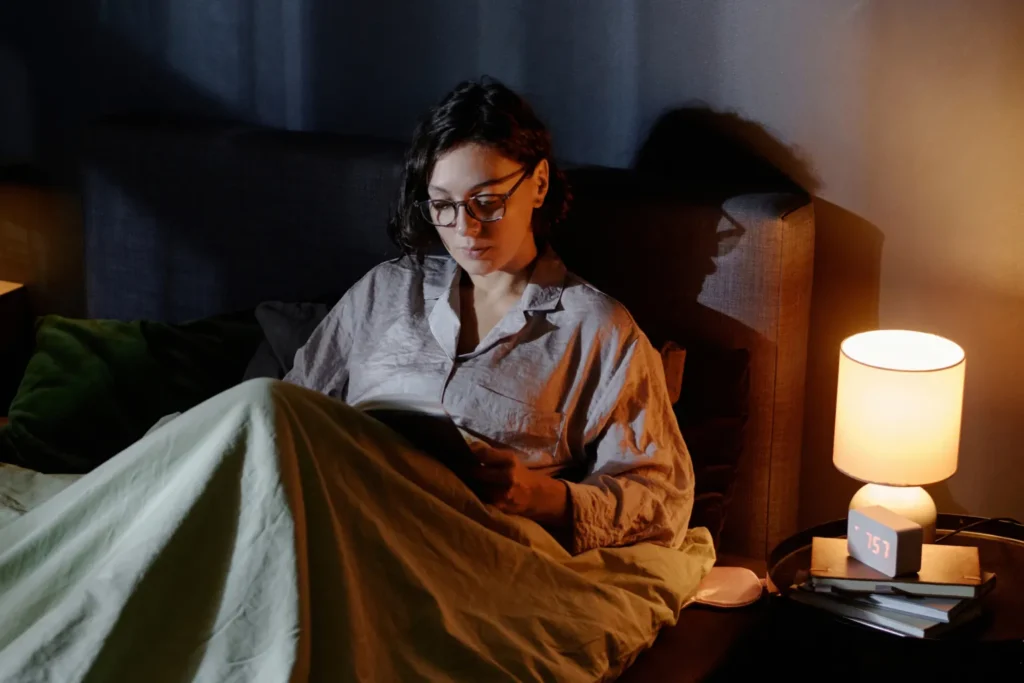
Some healthcare professionals become genuinely disciplined about sleep once it becomes a problem.
They:
- black out the bedroom completely
- keep as consistent a schedule as shift work allows
- cut screens well before bed
- follow every sleep hygiene recommendation they can find
- they even try melatonin or other supplements, even though the evidence is weak or mixed
And these sleep hygiene interventions help, to a point.
Then, often on the nights that matter most, something familiar happens anyway. Falling asleep easily, then waking at 3am fully alert. Getting the hours, but not the sense of having recovered. A kind of restlessness that no amount of blackout curtains seems to touch.
This isn’t a discipline problem. It isn’t proof that the sleep hygiene checklist was followed incorrectly. In some cases, years of irregular, high-stakes shifts may leave the nervous system more prone to staying alert even once the actual demand has passed.
Sleep Hygiene vs. A Nervous System Stuck in Alert Mode
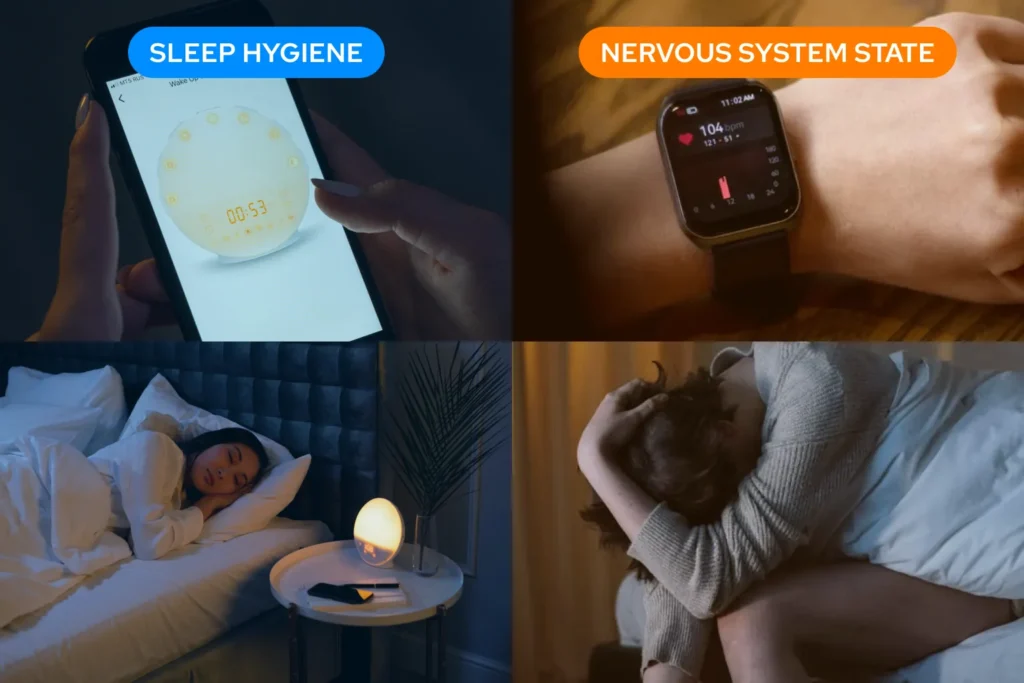
Sleep hygiene is what most advice addresses. And that’s the foundational component of any sleep intervention.
But underneath the environment and the habits, the autonomic nervous system can still be stuck in a pattern of prolonged alertness, even once the external demand, the shift, the decision, the emergency, has actually ended.
Chronic occupational stress, the kind built from years of high-stakes decisions, emotional absorption, and irregular shift patterns, is associated with measurable, lasting changes in autonomic regulation.¹,² That’s a different claim than “you’re just not sleeping enough.” It means getting enough hours may not tell the whole story if the autonomic nervous system is still struggling to shift efficiently out of a prolonged state of alert.
Blacking out the room changes the environment. It doesn’t necessarily change the state of the nervous system inside it.
The Nervous System’s Role in Sleep That Doesn’t Fully Restore
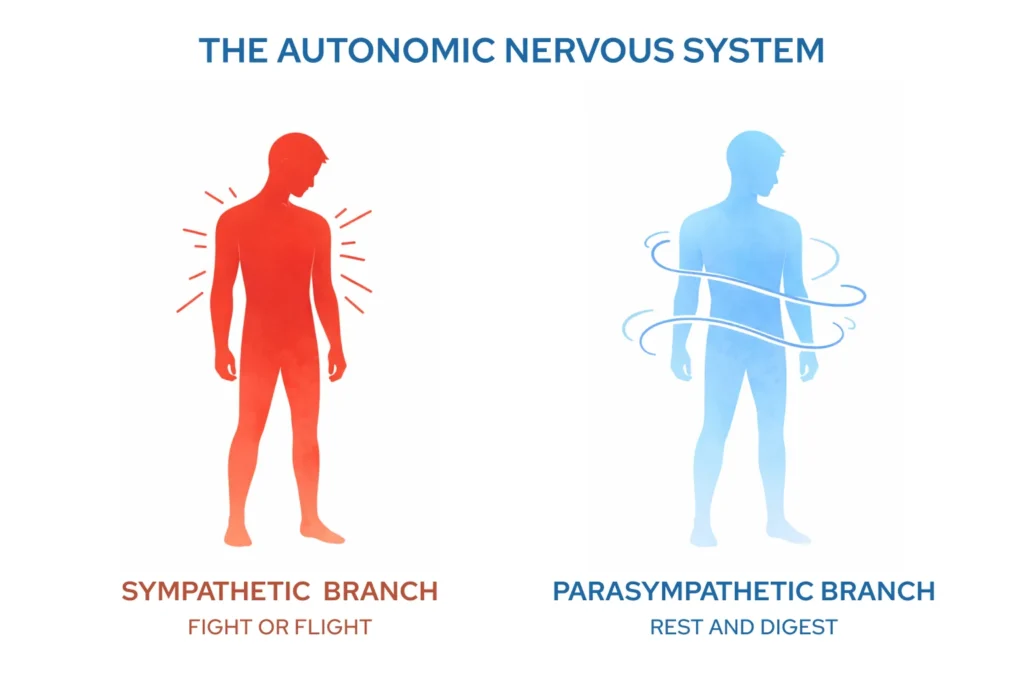
The autonomic nervous system has two primary branches.
Sympathetic (“fight or flight”), associated with alertness, rapid decision-making, and short-term performance under pressure.
Parasympathetic (“rest and digest”), which supports rest, digestion, and physiological recovery.
Shift-based clinical work is, structurally, built to keep the sympathetic branch engaged well past the hours it’s actually needed. Rapid decisions during the shift. Adrenaline with no obvious off-ramp once the shift ends. Years of that pattern may leave the system more prone to staying alert even during designated sleep windows.
Over time, some people stop consciously noticing this. They just notice the downstream effects: sleep that happens but doesn’t restore, a baseline restlessness that seems to sit underneath everything, including on nights off.
The Vagus Nerve: A Key Pathway in the Body’s Recovery Response
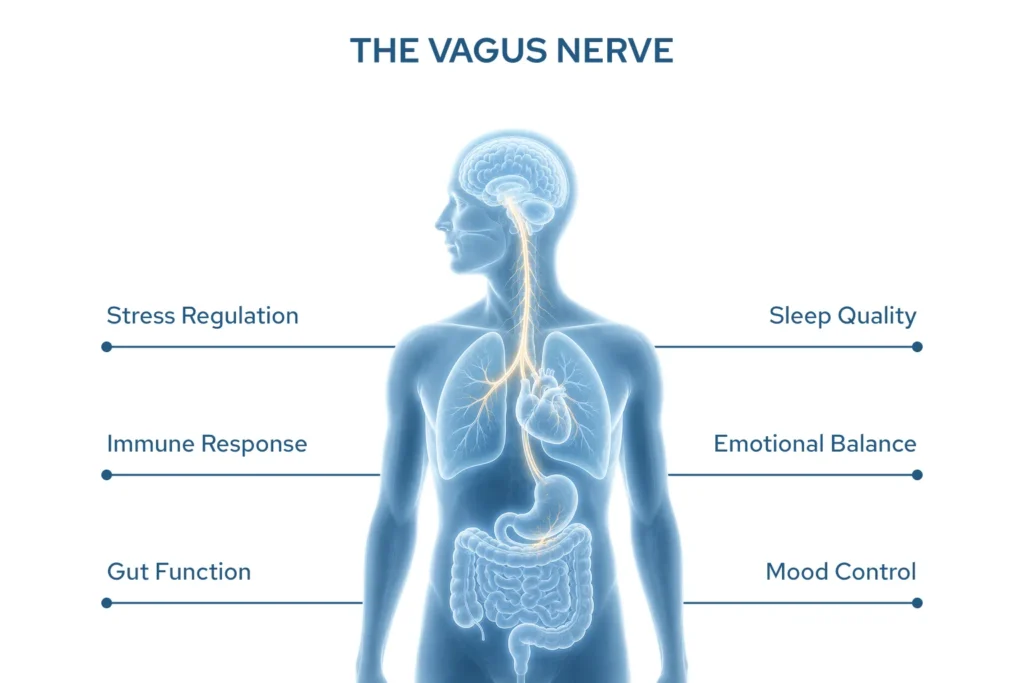
One of the main pathways involved in that shift is the vagus nerve, a major pathway of the parasympathetic nervous system, playing an important role in autonomic regulation and recovery.
When vagal activity is functioning well, the body tends to move out of alert mode more efficiently. Breathing slows. The system doesn’t stay on standby indefinitely.
When the nervous system has been under sustained pressure for long enough, often years, in clinical careers with irregular shifts, that shift can become less efficient. Reduced vagal activity is one marker researchers have studied in relation to how effectively the autonomic nervous system regulates and recovers from chronic stress.³
That’s part of why, reviewing this literature, I became more interested in approaches that support the nervous system’s own recovery signal directly, rather than only adjusting the environment around it.
What the Research Actually Shows: Sleep, HRV and Fatigue
I want to be precise about what’s established here versus what’s still developing.
Sleep hygiene works. Melatonin is recommended only for specific disorders and certain populations.¹⁰ Blackout curtains and consistent bedtimes can help. I’m not disputing any of that. But for shift-based clinicians, these approaches don’t always address the physiological arousal that can persist after the external demand has ended.
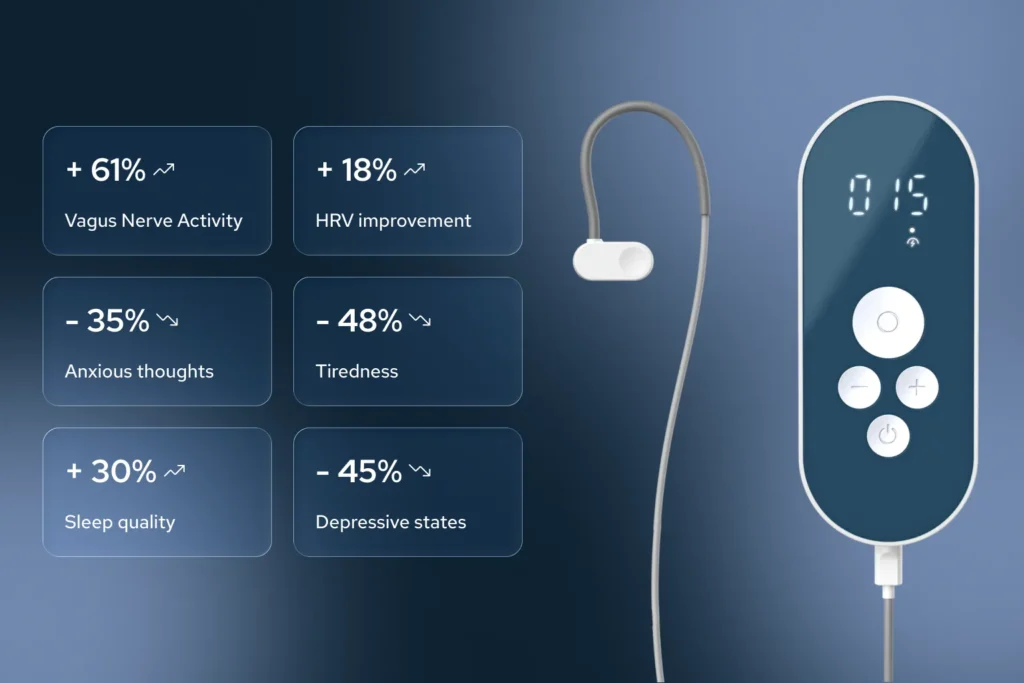
taVNS (transcutaneous auricular vagus nerve stimulation, a way of stimulating the vagus nerve through the outer ear without surgery) has been studied across several outcomes relevant to autonomic regulation, fatigue and sleep. In peer-reviewed, placebo-controlled research, it has been associated with:
- Measurable improvements in sleep quality⁴
- Increased HRV (Heart Rate Variability), a marker of how effectively the autonomic nervous system shifts into recovery⁵
- Reductions in fatigue and tiredness scores⁶
**Safety data across more than 60 published studies report no serious adverse events to date when used as directed.**⁷,⁸
This is the same underlying mechanism used by devices like Nuropod.⁹
Where Nuropod Fits
I want to be direct about something, because I think healthcare professionals in particular have good instincts for spotting overreach. I’m not saying a device replaces adequate staffing, protected time off, sleep hygiene, or addressing what’s genuinely unsustainable about shift patterns. It doesn’t, and nothing should claim otherwise.
What the evidence points to is narrower, and I think more useful: for shift workers whose sleep doesn’t fully even when the hours are technically there, part of what’s missing may be direct support for the nervous system’s own recovery signal in addition to a sound sleep hygiene program.
Nuropod is a taVNS device, using proprietary AVNT™ (Auricular Vagal Neuromodulation Technology), that delivers a calibrated signal to the auricular branch of the vagus nerve. That branch is, by current anatomical understanding, the only point where the nerve reaches the surface of the body without surgery, through a small clip worn on the ear.
For people already working shifts that don’t leave room for a new wellness routine, that matters practically. Sessions run 15 to 30 minutes and don’t require a quiet room or a carved-out block of time, no gel, nothing that asks for effort a depleted nervous system doesn’t have to spare. Importantly in this context, this device does not require an app. That means it can perfectly fit into a sleep hygiene routine that includes avoiding screens before bedtime. It’s built to run in the background of whatever the evening looks like, including the ones that start at an unusual hour.
I use it myself, most nights. Subjectively, I stay asleep through the night more consistently with it than without, though I want to be honest that I haven’t measured this with a wearable, and I’d treat that as one data point, not evidence.
What This Can Look Like in Real Life
The rotating shift nurse who’s tried everything. Blackout curtains, consistent schedule where possible, melatonin. Sleep hygiene helps, then a bad rotation resets it back to square one.
The on-call physician who sleeps but doesn’t recover. Gets the hours between calls, wakes up without the sense that anything was repaired.
The night-shift worker who’s fine falling asleep, not staying asleep. Out within minutes, then wide awake at an hour that has nothing scheduled in it.
Who Might Benefit, and Who Shouldn’t Use It
Might benefit:
- People working rotating, night, or on-call shifts whose sleep hygiene routine hasn't fully solved the problem
- Anyone who falls asleep fine but wakes in the middle of the night fully alert
- People getting the hours but not waking up feeling recovered
- Those looking for something that fits inside a shift pattern, not something that asks for a spare hour they don't have
Avoid if:
- You have a pacemaker or implanted cardiac device
- You are pregnant
- You've recently experienced a serious cardiac event
- You are under 18
Always consult a healthcare professional before starting.
Final Thoughts: Treat the System, Not Just the Environment
Blackout curtains matter. Consistent schedules matter, where shift patterns allow them. Addressing what’s structurally unsustainable about a rotation matters, and no device changes that.
But sleep that doesn’t restore, even when the hours are technically there, might point to something that’s not being addressed. For a meaningful number of shift-based healthcare professionals, part of that picture may be a nervous system that’s been asked to stay switched on for years, and has become less efficient at shifting back into a state that supports restorative sleep.
I stepped away from a surgical career for reasons that felt personal and practical at the time: the hours, the lifestyle. It took years of reading the evidence, professionally, to understand the fuller picture of what irregular, high-stakes schedules can do to a nervous system, and to sleep specifically, over time.
If you’ve been trying to improve your sleep without lasting results, it may be time to look deeper than the room and the routine.
References
- Yaribeygi H, et al. The impact of stress on body function: A review. EXCLI Journal. 2017. https://pmc.ncbi.nlm.nih.gov/articles/PMC9300510/
- Kim HG, et al. Stress and heart rate variability: A meta-analysis and review of the literature. Psychiatry Investigation. 2018. https://doi.org/10.30773/pi.2017.08.17
- Thayer JF, et al. A meta-analysis of heart rate variability and neuroimaging studies: implications for heart rate variability as a marker of stress and health. Neuroscience and Behavioral Reviews. 2012. https://doi.org/10.1016/j.neubiorev.2011.11.009
- Zhang S, et al. Transcutaneous Auricular Vagus Nerve Stimulation for Chronic Insomnia Disorder: A Randomized Clinical Trial. JAMA Network Open. 2024;7(12):e2451217. https://doi.org/10.1001/jamanetworkopen.2024.51217
- Geng D, et al. The effect of transcutaneous auricular vagus nerve stimulation on HRV in healthy young people. PLoS ONE. 2022. https://doi.org/10.1371/journal.pone.0263833
- Tarn J, et al. The effects of noninvasive vagus nerve stimulation on tiredness. Neuromodulation. 2023;26(3):681-689. https://doi.org/10.1016/j.neurom.2022.08.461
- Redgrave J, et al. Safety and tolerability of transcutaneous vagus nerve stimulation in humans: a systematic review. Brain Stimulation. 2018;11(6):1225-1238. https://doi.org/10.1016/j.brs.2018.08.010
- Kim AY, et al. Safety of transcutaneous auricular vagus nerve stimulation (taVNS): A systematic review and meta-analysis. Scientific Reports. 2022. https://doi.org/10.1038/s41598-022-25864-1
- Parasym Ltd. Nuropod certification information. 2024. https://care.nuropod.com/hc/en-us/articles/25945331731597-Is-Nuropod-a-certified-device
- Sateia MJ, Buysse DJ, Krystal AD, Neubauer DN, Heald JL. Clinical Practice Guideline for the Pharmacologic Treatment of Chronic Insomnia in Adults: An American Academy of Sleep Medicine Clinical Practice Guideline. Journal of Clinical Sleep Medicine. 2017;13(2):307-349.
This article is published in partnership with Nuropod. It reflects my professional evaluation of publicly available evidence and is intended for informational purposes only. It is not a substitute for professional medical advice. I may receive compensation for purchases made through links in this article. Individual results may vary. Always consult a qualified healthcare professional before starting any new intervention.