What I found out after years of looking fine on the outside while feeling permanently switched on inside.

The Part I Got Wrong for Years
I’ve spent over a decade coaching men on training, nutrition, and recovery. I track my own numbers obsessively. If there’s a system in the body I could optimize, I’ve probably already tried.
There was one system I never actually paid attention to: my own stress response.
I trained my body for years. I never trained the part of me that decides whether stress passes through or sticks around.
From the outside, everything looked fine. Work. Training. Showing up for my family. Hitting my goals.
Internally, my brain wouldn’t stop. Not panic. Not crisis. Just a low, constant hum that never fully switched off.
I assumed that was just what a full life felt like. It’s not. And once I understood why, the turned out to be smaller than I expected.
Why So Many Dads Carry It Silently
I’ve worked with thousands of men over the years. The pattern I keep seeing has almost nothing to do with their programming.
A lot of them are running on the same script: keep it together, be the rock, don’t make it anyone else’s problem.
Ask most men how they’re doing and you’ll get “stressed,” “burnt out,” “just tired,” or “fine,” even when fine is doing a lot of heavy lifting in that sentence.
That’s not evasion. It’s often the only vocabulary available. Some research suggests boys are socialised to express emotion differently than girls are from an early age, one factor researchers have pointed to in why many men default to functional words like “stressed” or “fine” rather than naming what they’re actually feeling.¹
Research on barriers to men’s help-seeking keeps pointing to the same things. Cost is a real, commonly cited barrier. And underneath that sits something deeper: for a lot of men, the belief that needing help is incompatible with being capable and self-sufficient runs quietly under most of their decisions, whether they’d say it out loud or not.²
So instead of talking, most dads just carry it. Working. Training. Showing up. Answering emails. Driving kids to practice. Smiling when someone asks how it’s going.
That’s the whole thing. From the outside, everything is fine.
The Real Reason It Doesn’t Just Go Away
Here’s what I didn’t understand until I actually looked into it.
When stress runs long enough, activity in the sympathetic nervous system (SNS), your body’s alert setting, can remain elevated well past the point it’s actually needed. It doesn’t know the workday is over. It doesn’t know the house is quiet. If the body doesn’t get real chances to shift into recovery, that heightened state carries into the evening and makes it harder to properly unwind.
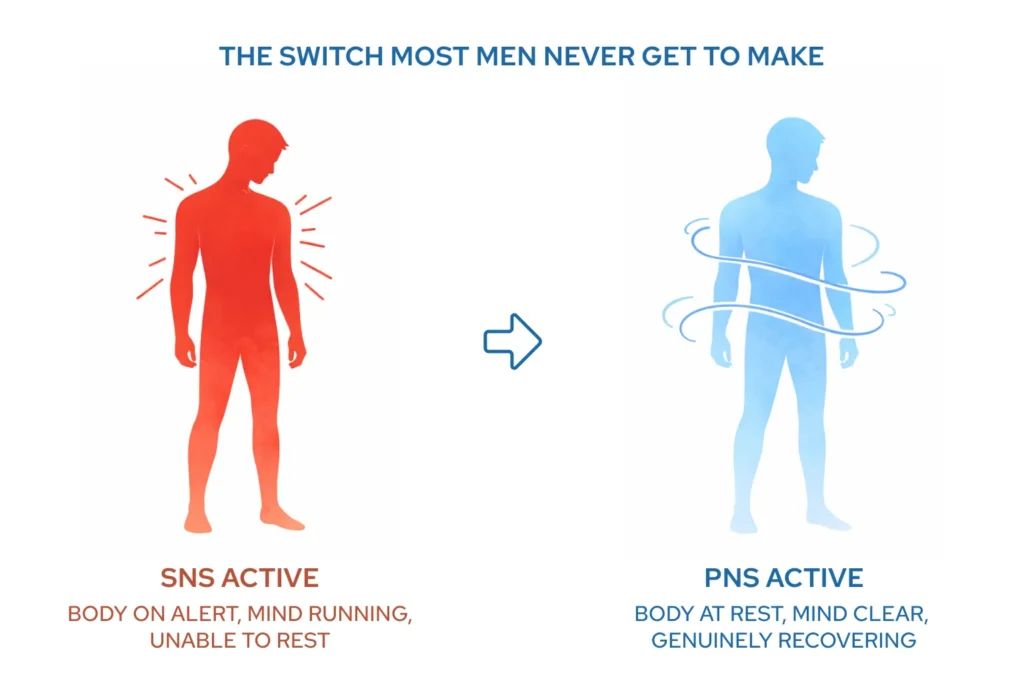
Over time, this can show up as:
- Sleep that doesn't restore, you get the hours but never feel recharged
- A shorter fuse than usual, snapping at things that wouldn't normally get to you
- That "on edge, can't switch off" feeling even in a quiet moment
- Mental tiredness that coffee doesn't touch
- Going through the motions without really being present
- Physical tension, a tight chest or tense shoulders, you only notice once someone points it out
This isn’t weakness. It’s a stress response doing exactly what it was built to do, just staying active for longer than is actually useful.
And it’s not a newborn-stage thing that fades once the kids get older. My kids aren’t babies anymore. The switch that’s supposed to turn this off doesn’t come with an expiry date on the hard part.
Why the Usual for Training, Sleep and Recovery Are Hit or Miss
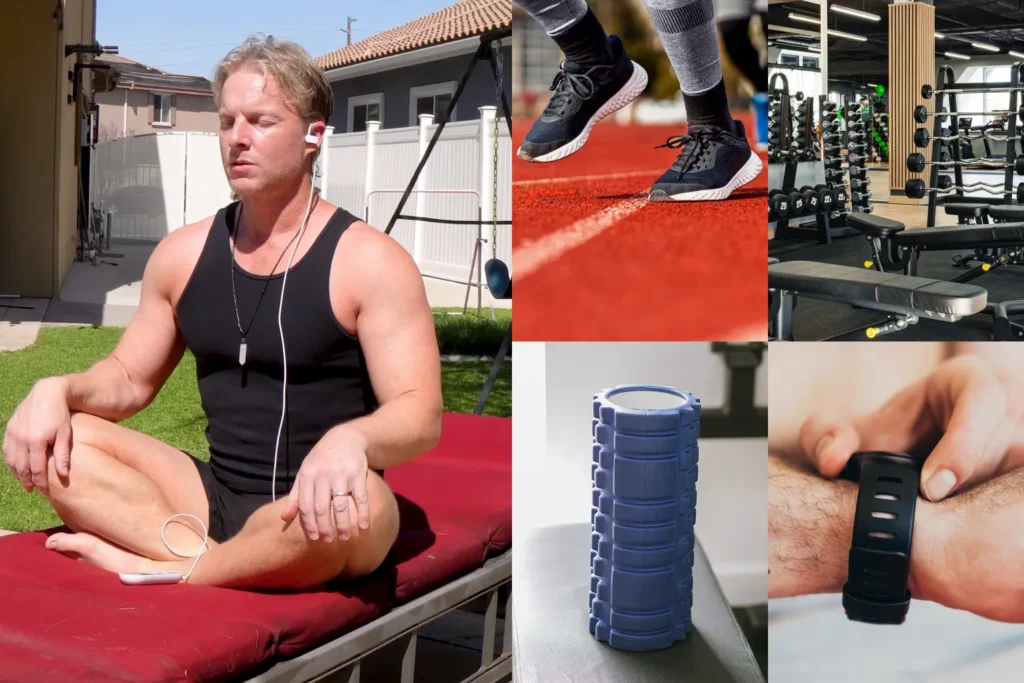
The tools most men actually reach for aren’t wrong. Lifting, a hard run, gaming to switch off, a drive with music turned up, working more to feel like you’re at least handling something. Most of us do some version of this.
Training is one of the most effective things you can do for your nervous system long-term, and I still do it consistently. But it’s also a physiological stressor in the short term. If you’re already under-recovered, adding more load on top can make things harder, not easier.
Box breathing shows up a lot too, four counts in, hold, four counts out, hold, used to override that fight-or-flight spike. It genuinely works. But it needs a moment of privacy and enough headspace to actually do it, exactly what’s in short supply on the day you need it most.
Sleep is non-negotiable. But stress makes it harder to fall asleep, stay asleep, or wake up feeling like anything was repaired, even when you’re technically getting enough hours.
None of these are wrong. They’re just hard to lean on consistently when the week that needs them most is also the week you have the least time, quiet, or headspace to spare.
Which made me start asking a different question: what if there was also a way to support that system directly, without needing another perfect recovery routine?
The Nerve Most Men Have Never Heard Of
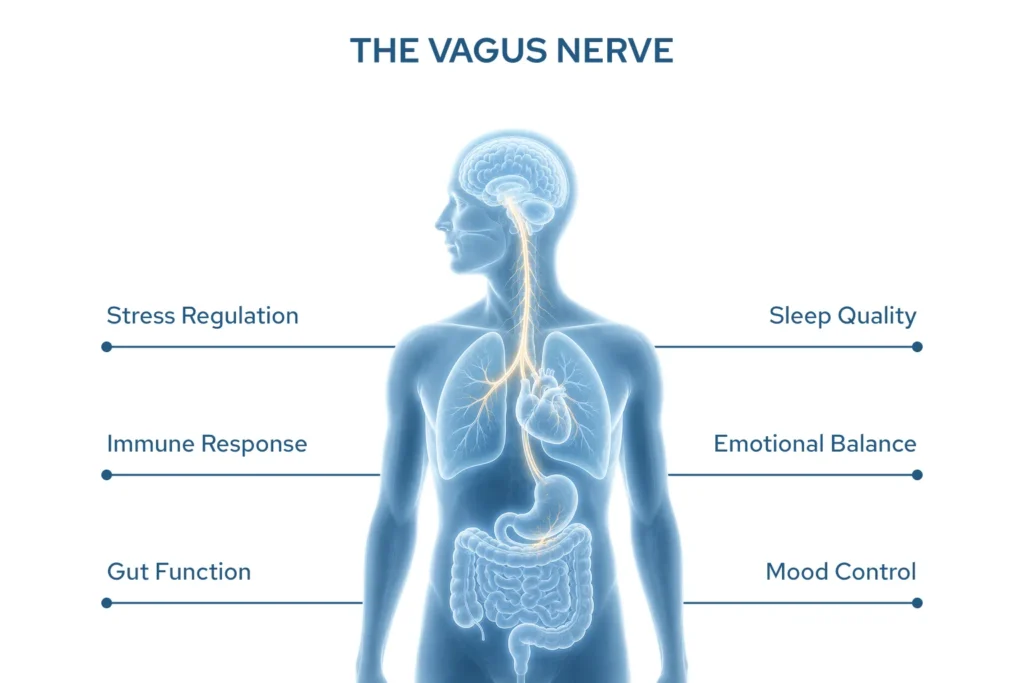
The vagus nerve is one of the body’s major communication pathways between the brain and organs including the heart, lungs, and digestive tract. It’s central to how your body shifts between alertness and recovery.
Until I looked into this properly, I’d heard the term but had no real sense of what it did.
When the vagus nerve is doing its job well, your nervous system moves naturally between alert and recovery states. When the immediate pressure passes, the parasympathetic nervous system (PNS), the “rest and recover” branch, can help the body settle back down. Think of it as tapping the brake pedal on a system that’s been running the accelerator too long.
The goal isn’t to “fix” a broken nervous system. It’s to support its ability to move more efficiently between alertness and recovery.
The Secret Routine
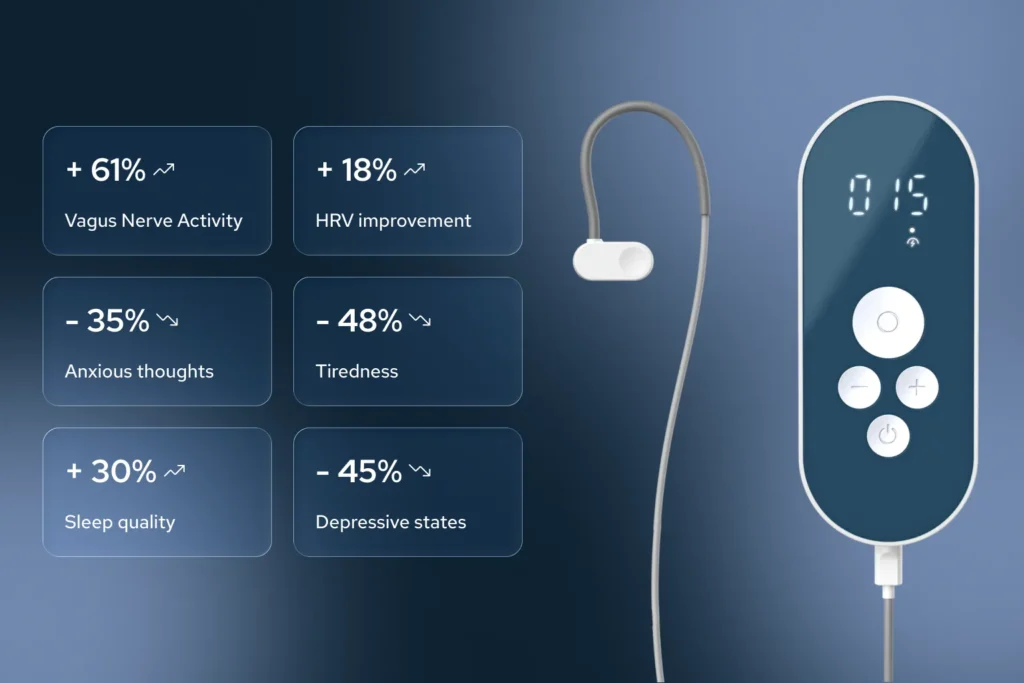
As I looked into this further, one non-invasive approach kept appearing across the research: taVNS (transcutaneous auricular vagus nerve stimulation), stimulation of the vagus nerve delivered through the outer ear.
I want to be straight about what the evidence actually supports here. In one randomised, sham-controlled study, 72 adults with chronic sleep problems used this kind of stimulation twice daily for 8 weeks, and researchers measured meaningful improvement in sleep quality, along with improvements in tiredness and self-reported mental wellbeing, compared to the sham group.³ That’s controlled evidence for the taVNS approach itself, not just general vagus nerve theory.
I’m not going to tell you this treats depressive states or anxious thoughts as a symptom, and it’s not a replacement for therapy if that’s what you actually need. What the research supports is narrower than that: support for sleep and stress regulation. For a lot of dads, that’s still the part that’s been missing.
The device that uses this same non-invasive auricular approach is called Nuropod. It’s a non-invasive wearable that stimulates the vagus nerve through the ear, using proprietary AVNT™ (Auricular Vagal Neuromodulation Technology), backed by scientific studies at institutions including the University of Pennsylvania, UCL, and UCLA, and used by more than 1,000 healthcare professionals. Safety reviews across taVNS studies report no serious adverse events to date when used as directed.⁴
As a fitness coach, I evaluate health claims carefully. Most wellness products promise more than they deliver. What changed my view wasn’t the concept alone, it was how specific the research on auricular vagus nerve stimulation actually was.
Sessions run 15 minutes minimum, and I actually do 30 in the morning and 30 before bed. No app, no gel, nothing to set up, nothing to explain to anyone. It’s become part of the rhythm of the day rather than an extra task on top of it.
You can use it while:
- Drinking your morning coffee before the house wakes up
- Watching something once the kids are down
- Reading before sleep
- Sitting in the car after a long day
- At your desk during a quiet break
I didn’t see it as replacing the basics, training, sleep, nutrition, or talking to someone if that’s what’s actually needed. I saw it as something that could support the system underneath all of that, without asking for another hour I didn’t have.
It doesn’t fix the chaos of parenting. I checked. Parenting will always be a little chaotic, and honestly, I wouldn’t want it any other way. But your nervous system doesn’t have to stay on high alert the whole time, and feeling more regulated can change how you show up for the people who need you.
What Other Dads Are Noticing

Most of what I’ve heard from other guys who’ve tried this isn’t dramatic. That’s actually the part that convinced me it wasn’t hype.
It’s a shorter temper cooling off faster than it used to. A quieter mind at the point in the evening that used to be the hardest. Falling asleep without replaying the day first.
Nobody’s describing a personality change. They’re describing a system that finally has room to catch up.
Who This Might Be For
The dad who’s been running on “I’m fine” for longer than he’d admit.
The guy who trains, eats well, does the right things, and still can’t figure out why his recovery hasn’t caught up.
The one whose kids are past the newborn stage, and still can’t explain why he feels this stretched.
Worth exploring if:
- You can't fully switch off, even when you want to
- Sleep doesn't feel regardless of how many hours you get
- You've noticed a shorter fuse than usual
- You want something private and quick, not another routine to explain to anyone
This isn’t for you if you’re looking for a solution for depressive states, anxious thoughts, or trauma, or a replacement for therapy. If that’s where you’re at, please talk to someone, a health professional, a therapist, or a friend you trust. That matters more than any device.
Avoid it if you have an implanted cardiac device, are pregnant, have had a serious cardiac event in the last five years, or are under 18. Always check with a healthcare professional first.
Final Thoughts
Most men carry more than they show.
Looking back, I don’t think I needed to become mentally tougher. I needed to stop believing that carrying everything silently was what strength looked like, and start giving my stress response the same attention I’d give any other system in my body.
I wouldn’t have called what I was carrying a problem. It was just the background hum of a full life, work, training, family, all the things worth having. But a full life isn’t supposed to leave your body braced for something that already happened.
I just wish I’d understood that years earlier.
If you don’t notice the difference you need, Nuropod offers a full refund.
References
- Chaplin TM, Aldao A. Gender differences in emotion expression in children: a meta-analytic review. Psychological Bulletin. 2013;139(4):735-765. https://doi.org/10.1037/a0030737
- Systematised literature review of barriers to help-seeking in men with mental health issues. Mental Health Practice, RCNi. 2025. https://journals.rcni.com/mental-health-practice/evidence-and-practice/barriers-to-helpseeking-in-men-with-mental-health-issues-a-systematised-literature-review-mhp.2025.e1748/abs
- Zhang S, et al. Transcutaneous Auricular Vagus Nerve Stimulation for Chronic Sleep Problems: A Randomized Scientific Study. JAMA Network Open. 2024;7(12):e2451217. https://doi.org/10.1001/jamanetworkopen.2024.51217
- Redgrave J, et al. Safety and tolerability of transcutaneous vagus nerve stimulation in humans: a systematic review. Brain Stimulation. 2018;11(6):1225-1238. https://doi.org/10.1016/j.brs.2018.08.010
This blog post aims to be informational and should not replace professional health advice. Always consult with a health professional for personalised advice. This article may contain affiliate links.