
What my husband Brad and I discovered after years of doing everything right as parents – and still not recovering.

When You’re Doing Everything Right – But Still Can’t Switch Off
The kids are finally asleep.
The house is quiet. You’ve been waiting for this moment all day.
And yet – instead of relaxing – your brain immediately starts running again. School tomorrow. The permission slip. Whether the kid’s temperature was actually normal or whether you should check again.
You’re exhausted. But you can’t rest.
You find yourself standing outside the kids’ bedroom, listening. Are they really asleep this time? You check one more time before getting into bed. Just in case.
If this sounds familiar, you’re not alone. Most parents assume this is just what parenting feels like. You push through, you tell yourself it’ll get easier, you try to sleep when the kids sleep.
But here’s what we didn’t understand until it happened to us: this isn’t just tiredness. Broken sleep is part of it – but there’s something else happening underneath that nobody talks about.
Before we had kids, Brad and I thought we understood what tired meant. It just went to a whole new level after having kids.
What We Kept Noticing – And Couldn’t Explain

We’d put the kids to bed. The hardest part of the day was over.
And yet neither of us felt like it was over.
We’d lie awake with our minds already running through tomorrow. One of us would wake up before the kids did, already tense. We felt wired in the evenings and heavy in the mornings. Shorter patience. More tension. Worse sleep – even when we technically got enough hours.
I’m a fitness and nutrition coach. I think about recovery for a living. Training, nutrition, sleep optimization – it’s what I do. And I couldn’t explain why none of it was working.
It took us a while to understand what was actually happening.
It wasn’t that we needed more sleep. We needed our bodies to recognise that it was finally safe to rest.
The Part Nobody Warns You About
Most parenting advice focuses on sleep. Get more of it. Protect it. Sleep when the kids sleep.
But sleep deprivation and nervous system dysregulation are two different problems.
Sleep deprivation is about quantity – not enough hours. Nervous system dysregulation is about state – your body doesn’t know it’s safe to recover, even when you have the hours.
Your nervous system doesn’t automatically know when the kids have gone to sleep.
Even when they’re finally sleeping, you stay awake finishing all the things you couldn’t do until now.
When you’re simply carrying the constant mental load of keeping small humans alive – your body activates what researchers call the sympathetic nervous system (SNS) – the “fight or flight” state. Alert. Ready. On.
This is exactly what the situation requires. It’s what gets you through.
The problem is what happens when it never switches off.
The SNS doesn’t know the kids are asleep. It doesn’t know that nothing needs to be done at 2 am. Without a clear signal that it’s safe to rest, it keeps running – at a low hum – through the evenings, through the night, into the next morning.
Over time, this shows up as:
- Sleep that doesn't feel restorative even when you get enough hours
- Irritability over things that wouldn't normally bother you
- Physical tension you only notice when someone points it out
- That "wired but tired" feeling - completely exhausted but unable to properly switch off
- Losing patience in moments where you actually wanted to be present
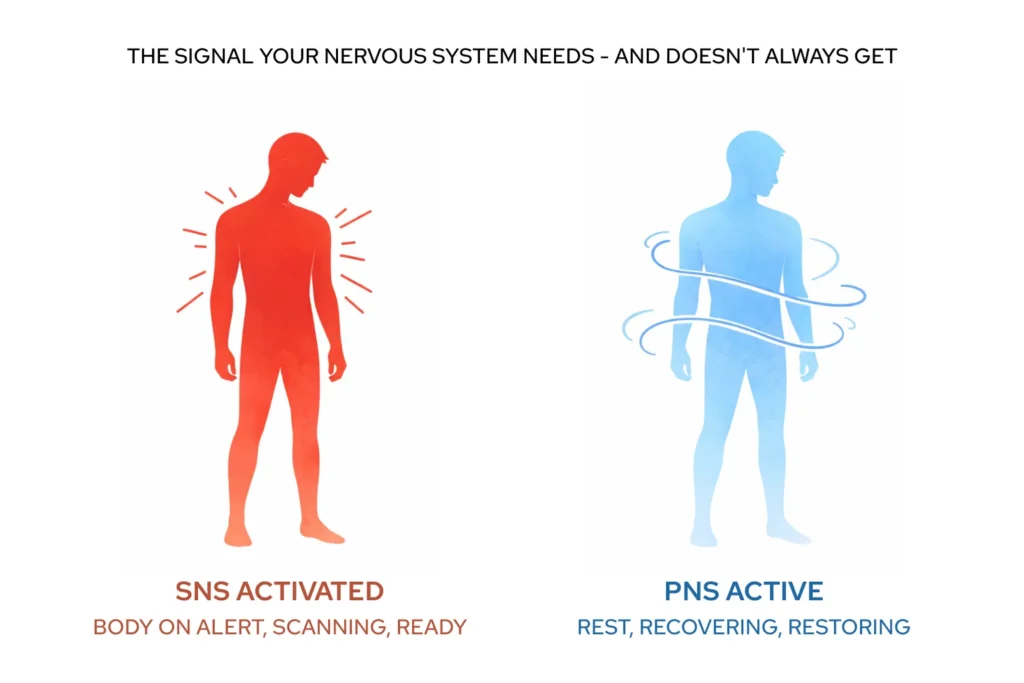
This isn’t poor stress management. It’s not a character flaw. It’s a nervous system doing exactly what it was designed to do – just without the off switch.
Why “Just Relax” Advice Makes It Harder
- Meditation - works, but needs quiet and a mind willing to slow down. After a full parenting day, sitting still with your thoughts can feel like the moment everything you've been holding together finally arrives at once.
- Breathwork - activates recovery pathways, but requires several uninterrupted minutes of focus. Not easy when your kid could call out any second.
- Exercise - one of the best things you can do, and I still do it. But on the hardest days, it's the first thing to go. And it asks for time & energy you may not have.
- Sleep hygiene routines - helpful, but they address the factors around sleep, not the nervous system state that's making sleep non-restorative in the first place.
There’s something else nobody mentions: being told you need another hour of self-care when you’re already overwhelmed can actually create more stress, not less. Finding the time, feeling guilty when you don’t – it becomes one more thing on a list that’s already too long.
The issue isn’t that parents don’t want to recover. It’s that most recovery methods were designed for lives that have clear boundaries between “on” and “off.”
Parenting doesn’t have those boundaries.
Which made us start wondering: what if there was a way to support the nervous system that worked inside the chaos – not outside it?
The Switch That Changes Everything
That question kept bringing us back to one thing: the vagus nerve.
Until then, I’d heard the name before – but never really understood what it actually did.
The vagus nerve (the longest nerve in the body, running from the brainstem through the chest and abdomen, connecting the brain to the heart, lungs, gut and immune system).
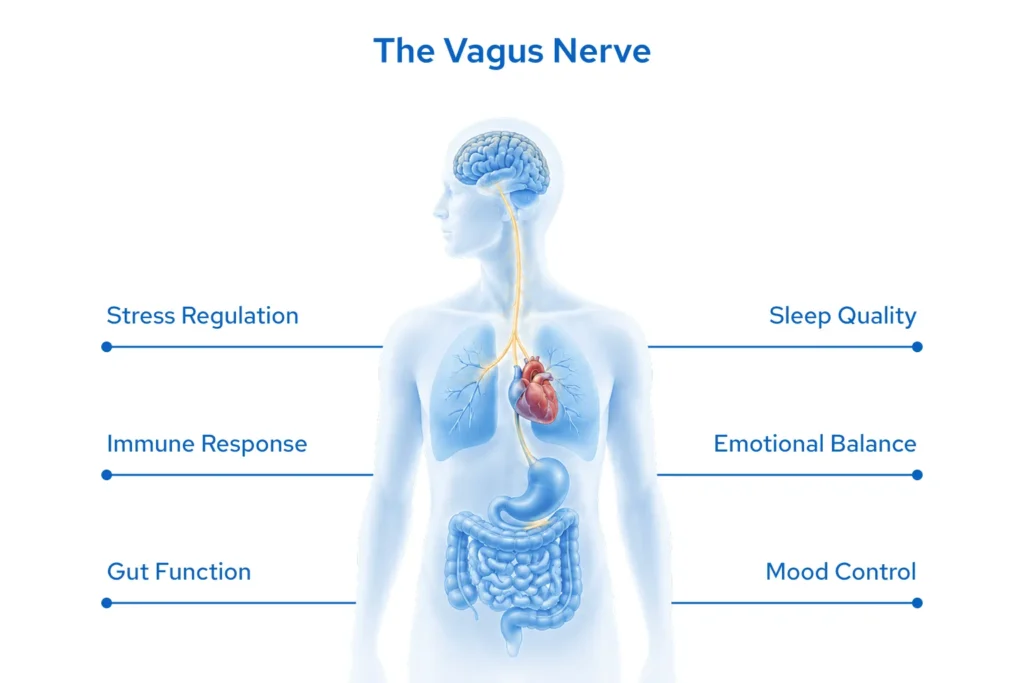
Think of it as the body’s primary “calm down” switch. When vagal tone (the measure of how well this nerve is functioning) is healthy, your nervous system shifts between alert and recovery states naturally. The demand passes. The vagus nerve activates. The parasympathetic state (PNS – rest, digest, recover) kicks in. You can actually feel the evening become quiet.
When vagal tone is chronically low – from sustained stress, broken sleep, and the relentless mental load of parenting – that shift becomes harder. The body stays braced. The quiet evenings don’t feel quiet.
The nervous system isn’t broken. It just needs a clearer signal.
We started wondering whether anyone had actually studied this.
It turns out they had.
What the Research Shows
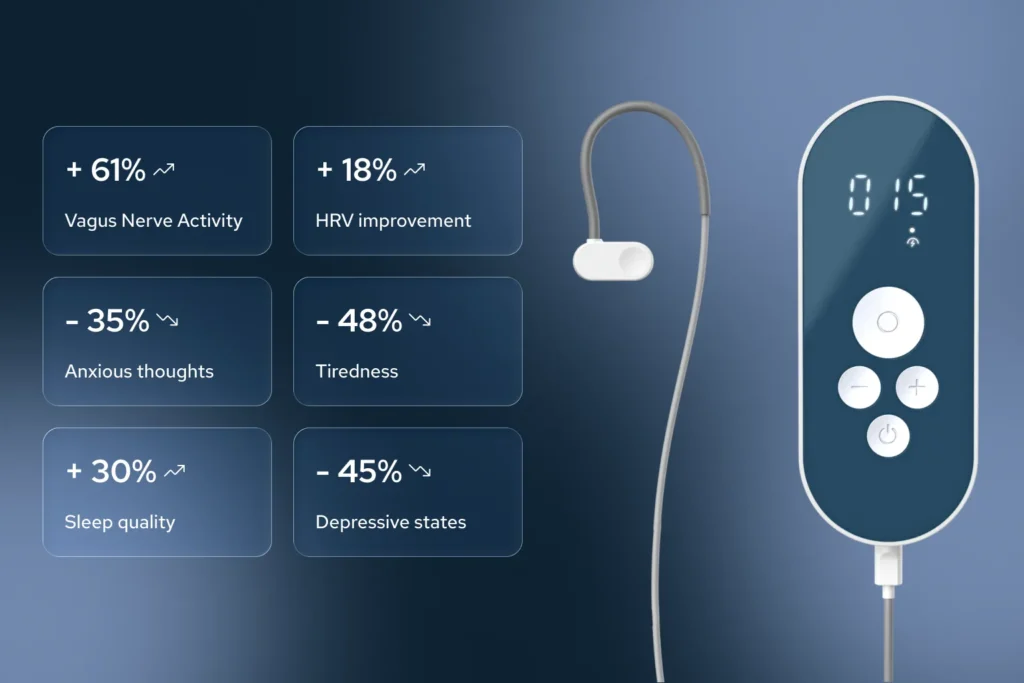
Result | Metric |
+61% | Vagus nerve activity (within 5 minutes of use) |
+30% | Sleep quality |
−35% | Anxious thoughts (10-day study) |
−45% | Depressive states / low mood |
−48% | Tiredness |
+18% | HRV (Heart Rate Variability – a measure of nervous system recovery) |
60+ completed studies. Zero serious adverse events reported to date.
We want to be honest: Nuropod doesn’t remove the chaos of parenting. Nothing does.
But what these numbers suggest is that supporting the nervous system directly – giving it the signal it needs to shift into recovery – can make a real difference to how you feel, sleep, and show up.
We kept reading. And eventually found something we hadn’t expected.
Where Nuropod Fits In
As fitness coaches, we evaluate health claims carefully. What shifted our thinking wasn’t the concept – it was the volume of peer-reviewed research behind it.
The device is called Nuropod.
Developed by Parasym – a company with 10+ years of R&D – Nuropod uses a gentle electrical signal through the ear to stimulate the vagus nerve directly, activating the same recovery pathway your body uses naturally.
It uses proprietary AVNT™ technology (Auricular Vagal Neuromodulation Therapy).
Trusted by 150+ internationally recognized institutions. 60+ completed studies. Recommended by 1,000+ healthcare professionals.
It’s not a replacement for sleep, nutrition, or movement. It’s a way to support the system underneath – so everything else can actually work.
How We Actually Use It
15 minutes. That’s all it takes.
We use it in the evenings while doing things we’re already doing – folding laundry, watching something together, sitting quietly after the kids go down.
You can use it while:
- Doing the dishes
- Folding the kids' laundry
- Meal prepping for the next day
- Reading before bed
- Sitting in the first quiet moment of the day
No special setup. No quiet room required. No extra mental energy.
It clips onto the ear with a small cable – simple and discreet. And it works during the life you actually have, not the one you hoped for.
What surprised us wasn’t dramatic. A few weeks in, the evenings felt different. The house would go quiet – and we’d actually feel it as quiet. Not as a window to process everything we hadn’t dealt with yet.
That was new.
Something else I noticed – my patience started to stretch. Those moments when the kids are fighting or having a meltdown, the ones that would normally make me feel tense and snappy – I found myself handling them with more calm. Less irritated. More present. More capable of just being there without feeling like I was about to snap.
Parents Who May Recognise This
- The new parent whose baby now sleeps through - but who still wakes at 2am, heart already racing, for no reason they can name.
- The toddler parent who describes their evenings as "finally sitting down - but not actually resting." Mind already on tomorrow.
- The working parent who gives everything at work, comes home to give everything to the kids, and has nothing left by 8pm - not even the energy to decompress.
- The fit, health-conscious parent who eats well, exercises, does everything right - and still can't understand why they feel so flat.
- The couple where both partners are exhausted, neither can support the other, and the evenings that should feel like connection just feel like survival.
Who This May Help
Nuropod may be worth exploring if:
- You lie awake after the kids go down, mind still running
- Sleep doesn't feel restorative regardless of how many hours you get
- You feel constantly "on" - even during rest
- You've tried the standard recovery advice and found it hard to sustain
- You want something that fits into the life you actually have
- You feel irritated by life and unable to appreciate the things you know you should
Please avoid it if you have an implanted cardiac device, are pregnant, have had a serious cardiac event in the last five years, or are under 18. Always check with your healthcare professional first.
Parenting will always be a little chaotic. We wouldn’t have it any other way.
But your nervous system doesn’t have to stay in survival mode the whole time.
It just needs the signal that it’s safe to stop.
For us, finding something that fit into the fifteen minutes we actually had – not the hour we didn’t – made all the difference. If you’re in the same place we were, it might be worth exploring.
This article reflects our personal experience and our evaluation of the available scientific evidence. We may receive a referral arrangement from purchases made through links in this article. This is not medical advice – always consult a qualified healthcare professional before starting any new intervention. Figures reflect relative change in peer-reviewed studies in specific study populations; individual results may vary.
– Jess Gouthro, Fitness Coach & Mother of 2 | LiveLeanTV | San Diego
This blog post aims to be informational and should not replace professional health advice. Always consult with a health professional for personalised advice.
References
- Verbanck P, et al. Transcutaneous auricular vagus nerve stimulation (taVNS) effects on tiredness, mood and autonomic function. Parasym Ltd peer-reviewed data. 2021.
- Zheng S, et al. Transcutaneous auricular vagus nerve stimulation reduces anxious thoughts: placebo-controlled study. Brain Stimulation. 2024.
- Dolcini J, et al. Effects of taVNS on sleep quality: randomised controlled study. Parasym Ltd. 2025.
- Geng D, et al. Effects of taVNS on heart rate variability: systematic review. Frontiers in Neuroscience. 2022. https://doi.org/10.3389/fnins.2022.872383
- Breit S, et al. Vagus nerve as modulator of the brain-gut axis in psychiatric and inflammatory disorders. Frontiers in Psychiatry. 2018;9:44. https://doi.org/10.3389/fpsyt.2018.00044
- Redgrave J, et al. Safety and tolerability of transcutaneous vagus nerve stimulation in humans: systematic review. Brain Stimulation. 2018;11(6):1225–1238. https://doi.org/10.1016/j.brs.2018.08.010